Integration by parts
| Part of a series of articles about | ||||||
| Calculus | ||||||
|---|---|---|---|---|---|---|
| ||||||
Differential
| ||||||
Integral
| ||||||
Series
| ||||||
Vector
| ||||||
Multivariable
| ||||||
Specialized
| ||||||
Glossary of calculus
| ||||||
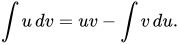
In calculus, and more generally in mathematical analysis, integration by parts or partial integration is a process that finds the integral of a product of functions in terms of the integral of their derivative and antiderivative. It is frequently used to transform the antiderivative of a product of functions into an antiderivative for which a solution can be more easily found. The rule can be derived in one line simply by integrating the product rule of differentiation.
If u = u(x) and du = u′(x) dx, while v = v(x) and dv = v′(x) dx, then integration by parts states that:
- ∫abu(x)v′(x)dx=[u(x)v(x)]ab−∫abu′(x)v(x)dx=u(b)v(b)−u(a)v(a)−∫abu′(x)v(x)dx{displaystyle {begin{aligned}int _{a}^{b}u(x)v'(x),dx&=[u(x)v(x)]_{a}^{b}-int _{a}^{b}u'(x)v(x)dx\&=u(b)v(b)-u(a)v(a)-int _{a}^{b}u'(x)v(x),dxend{aligned}}}
![{displaystyle {begin{aligned}int _{a}^{b}u(x)v'(x),dx&=[u(x)v(x)]_{a}^{b}-int _{a}^{b}u'(x)v(x)dx\&=u(b)v(b)-u(a)v(a)-int _{a}^{b}u'(x)v(x),dxend{aligned}}}](https://wikimedia.org/api/rest_v1/media/math/render/svg/88aa4b830425c067064d8b5f397f6ea52ed51ada)
or more compactly:
- ∫udv=uv−∫vdu.{displaystyle int u,dv=uv-int v,du.}
Mathematician Brook Taylor discovered integration by parts, first publishing the idea in 1715.[1][2] More general formulations of integration by parts exist for the Riemann–Stieltjes and Lebesgue–Stieltjes integrals. The discrete analogue for sequences is called summation by parts.
Contents
1 Theorem
1.1 Product of two functions
1.2 Extension to other cases
1.3 Product of many functions
2 Visualization
3 Applications
3.1 Strategy
3.1.1 Polynomials and trigonometric functions
3.1.2 Exponentials and trigonometric functions
3.1.3 Functions multiplied by unity
3.2 LIATE rule
3.3 Use in special functions
3.4 Use in harmonic analysis
3.4.1 Fourier transform of derivative
3.4.2 Decay of Fourier transform
3.5 Use in operator theory
3.6 Other applications
4 Repeated integration by parts
4.1 Tabular integration by parts
5 Higher dimensions
6 See also
7 Notes
8 References
9 External links
Theorem
Product of two functions
The theorem can be derived as follows. Suppose u(x) and v(x) are two continuously differentiable functions. The product rule states (in Leibniz's notation):
- ddx(u(x)v(x))=v(x)ddx(u(x))+u(x)ddx(v(x)).{displaystyle {frac {d}{dx}}{Big (}u(x)v(x){Big )}=v(x){frac {d}{dx}}left(u(x)right)+u(x){frac {d}{dx}}left(v(x)right).}

Integrating both sides with respect to x,
- ∫ddx(u(x)v(x))dx=∫u′(x)v(x)dx+∫u(x)v′(x)dx{displaystyle int {frac {d}{dx}}left(u(x)v(x)right),dx=int u'(x)v(x),dx+int u(x)v'(x),dx}

then applying the definition of indefinite integral,
- u(x)v(x)=∫u′(x)v(x)dx+∫u(x)v′(x)dx{displaystyle u(x)v(x)=int u'(x)v(x),dx+int u(x)v'(x),dx}

- ∫u(x)v′(x)dx=u(x)v(x)−∫u′(x)v(x)dx{displaystyle int u(x)v'(x),dx=u(x)v(x)-int u'(x)v(x),dx}

gives the formula for integration by parts.
Since du and dv are differentials of a function of one variable x,
- du=u′(x)dxdv=v′(x)dx{displaystyle du=u'(x)dxquad dv=v'(x)dx}

- ∫u(x)dv=u(x)v(x)−∫v(x)du{displaystyle int u(x),dv=u(x)v(x)-int v(x),du}

The original integral ∫uv′ dx contains v′ (derivative of v); in order to apply the theorem, v (antiderivative of v′) must be found, and then the resulting integral ∫vu′ dx must be evaluated.
Extension to other cases
It is not actually necessary for u and v to be continuously differentiable. Integration by parts works if u is absolutely continuous and the function designated v' is Lebesgue integrable (but not necessarily continuous).[3] (If v' has a point of discontinuity then its antiderivative v may not have a derivative at that point.)
If the interval of integration is not compact, then it is not necessary for u to be absolutely continuous in the whole interval or for v ' to be Lebesgue integrable in the interval, as a couple of examples (in which u and v are continuous and continuously differentiable) will show. For instance, if
- u(x)=exp(x)/x2,v′(x)=exp(−x){displaystyle u(x)=exp(x)/x^{2},,v'(x)=exp(-x)}

u is not absolutely continuous on the interval [1, +∞), but nevertheless
- ∫1∞u(x)v′(x)dx=[u(x)v(x)]1∞−∫1∞u′(x)v(x)dx{displaystyle int _{1}^{infty }u(x)v'(x),dx=left[u(x)v(x)right]_{1}^{infty }-int _{1}^{infty }u'(x)v(x),dx}
![{displaystyle int _{1}^{infty }u(x)v'(x),dx=left[u(x)v(x)right]_{1}^{infty }-int _{1}^{infty }u'(x)v(x),dx}](https://wikimedia.org/api/rest_v1/media/math/render/svg/833ef7b583a13159a2dc1d2838578a0d836c7d01)
so long as [u(x)v(x)]1∞{displaystyle left[u(x)v(x)right]_{1}^{infty }}![{displaystyle left[u(x)v(x)right]_{1}^{infty }}](https://wikimedia.org/api/rest_v1/media/math/render/svg/33ebe58682c1fc4b366c0f161e0931f5c4e05e33)



- u(x)=exp(−x),v′(x)=x−1sin(x){displaystyle u(x)=exp(-x),,v'(x)=x^{-1}sin(x)}

v' is not Lebesgue integrable on the interval [1, +∞), but nevertheless
- ∫1∞u(x)v′(x)dx=[u(x)v(x)]1∞−∫1∞u′(x)v(x)dx{displaystyle int _{1}^{infty }u(x)v'(x),dx=left[u(x)v(x)right]_{1}^{infty }-int _{1}^{infty }u'(x)v(x),dx}
with the same interpretation.
One can also easily come up with similar examples in which u and v are not continuously differentiable.
Further, if f(x){displaystyle f(x)}
![[a,b],](https://wikimedia.org/api/rest_v1/media/math/render/svg/2d493b840f8326ba81ff9d95b4edf1effd5f2842)

∫abf(x)φ′(x)dx=−∫−∞+∞φ~(x)d(χ~[a,b](x)f~(x)),{displaystyle int limits _{a}^{b}f(x)varphi '(x),dx=-int limits _{-infty }^{+infty }{widetilde {varphi }}(x),d({widetilde {chi }}_{[a,b]}(x){widetilde {f}}(x)),}
![{displaystyle int limits _{a}^{b}f(x)varphi '(x),dx=-int limits _{-infty }^{+infty }{widetilde {varphi }}(x),d({widetilde {chi }}_{[a,b]}(x){widetilde {f}}(x)),}](https://wikimedia.org/api/rest_v1/media/math/render/svg/352e90ffec9e6f1bb292d7d2831a300421772c68)
where by d(χ[a,b](x)f~(x)){displaystyle d(chi _{[a,b]}(x){widetilde {f}}(x))}![{displaystyle d(chi _{[a,b]}(x){widetilde {f}}(x))}](https://wikimedia.org/api/rest_v1/media/math/render/svg/3abd9a9aa2e95eea623a28975f4d536ba17027d2)
![{displaystyle chi _{[a,b]}(x)f(x)}](https://wikimedia.org/api/rest_v1/media/math/render/svg/e99ce592b8d5b5db6f27ca09b49a6792433fc7fb)

to R,{displaystyle mathbb {R} ,}

Product of many functions
Integrating the product rule for three multiplied functions, u(x), v(x), w(x), gives a similar result:
- ∫abuvdw=[uvw]ab−∫abuwdv−∫abvwdu.{displaystyle int _{a}^{b}uv,dw=[uvw]_{a}^{b}-int _{a}^{b}uw,dv-int _{a}^{b}vw,du.}
![int _{a}^{b}uv,dw=[uvw]_{a}^{b}-int _{a}^{b}uw,dv-int _{a}^{b}vw,du.](https://wikimedia.org/api/rest_v1/media/math/render/svg/6c4780b1c63fc473bb92fe91c34b22b8fd3870e5)
In general, for n factors
- ddx(∏i=1nui(x))=∑j=1n∏i≠jnui(x)duj(x)dx,{displaystyle {frac {d}{dx}}left(prod _{i=1}^{n}u_{i}(x)right)=sum _{j=1}^{n}prod _{ineq j}^{n}u_{i}(x){frac {du_{j}(x)}{dx}},}

which leads to
- [∏i=1nui(x)]ab=∑j=1n∫ab∏i≠jnui(x)duj(x),{displaystyle {Bigl [}prod _{i=1}^{n}u_{i}(x){Bigr ]}_{a}^{b}=sum _{j=1}^{n}int _{a}^{b}prod _{ineq j}^{n}u_{i}(x),du_{j}(x),}
![{Bigl [}prod _{i=1}^{n}u_{i}(x){Bigr ]}_{a}^{b}=sum _{j=1}^{n}int _{a}^{b}prod _{ineq j}^{n}u_{i}(x),du_{j}(x),](https://wikimedia.org/api/rest_v1/media/math/render/svg/405a9399c867d11f0a81b3d8a2d31b4428b3b282)
where the product is of all functions except for the one differentiated in the same term.
Visualization
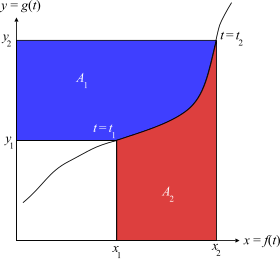
Graphical interpretation of the theorem. The pictured curve is parametrized by the variable t.
Consider a parametric curve by (x, y) = (f(t), g(t)). Assuming that the curve is locally one-to-one and integrable, we can define
- x(y)=f(g−1(y)){displaystyle x(y)=f(g^{-1}(y))}
- y(x)=g(f−1(x)){displaystyle y(x)=g(f^{-1}(x))}


The area of the blue region is
- A1=∫y1y2x(y)dy{displaystyle A_{1}=int _{y_{1}}^{y_{2}}x(y)dy}

Similarly, the area of the red region is
- A2=∫x1x2y(x)dx{displaystyle A_{2}=int _{x_{1}}^{x_{2}}y(x)dx}
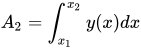
The total area A1 + A2 is equal to the area of the bigger rectangle, x2y2, minus the area of the smaller one, x1y1:
- ∫y1y2x(y)dy⏞A1+∫x1x2y(x)dx⏞A2=x⋅y(x)|x1x2=y⋅x(y)|y1y2.{displaystyle overbrace {int _{y_{1}}^{y_{2}}x(y)dy} ^{A_{1}}+overbrace {int _{x_{1}}^{x_{2}}y(x)dx} ^{A_{2}}={biggl .}xcdot y(x){biggl |}_{x_{1}}^{x_{2}}={biggl .}ycdot x(y){biggl |}_{y_{1}}^{y_{2}}.}

Or, in terms of t,
- ∫t1t2x(t)dy(t)+∫t1t2y(t)dx(t)=x(t)y(t)|t1t2{displaystyle int _{t_{1}}^{t_{2}}x(t)dy(t)+int _{t_{1}}^{t_{2}}y(t)dx(t)={biggl .}x(t)y(t){biggl |}_{t_{1}}^{t_{2}}}

Or, in terms of indefinite integrals, this can be written as
- ∫xdy+∫ydx=xy{displaystyle int xdy+int ydx=xy}
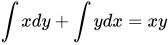
Rearranging:
- ∫xdy=xy−∫ydx{displaystyle int xdy=xy-int ydx}
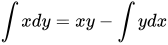
Thus integration by parts may be thought of as deriving the area of the blue region from the area of rectangles and that of the red region.
This visualization also explains why integration by parts may help find the integral of an inverse function f−1(x) when the integral of the function f(x) is known. Indeed, the functions x(y) and y(x) are inverses, and the integral ∫x dy may be calculated as above from knowing the integral ∫y dx. In particular, this explains use of integration by parts to integrate logarithm and inverse trigonometric functions.
Applications
Strategy
Integration by parts is a heuristic rather than a purely mechanical process for solving integrals; given a single function to integrate, the typical strategy is to carefully separate this single function into a product of two functions u(x)v(x) such that the residual integral from the integration by parts formula is easier to evaluate than the single function. The following form is useful in illustrating the best strategy to take:
- ∫uv dx=u∫v dx−∫(u′∫v dx) dx.{displaystyle int uv dx=uint v dx-int left(u'int v dxright) dx.}

Note that on the right-hand side, u is differentiated and v is integrated; consequently it is useful to choose u as a function that simplifies when differentiated, or to choose v as a function that simplifies when integrated. As a simple example, consider:
- ∫ln(x)x2 dx .{displaystyle int {frac {ln(x)}{x^{2}}} dx .}
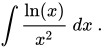
Since the derivative of ln(x) is 1/x, one makes (ln(x)) part u; since the antiderivative of 1/x2 is -1/x, one makes 1/x2dx part dv. The formula now yields:
- ∫ln(x)x2 dx=−ln(x)x−∫(1x)(−1x) dx .{displaystyle int {frac {ln(x)}{x^{2}}} dx=-{frac {ln(x)}{x}}-int {biggl (}{frac {1}{x}}{biggr )}{biggl (}-{frac {1}{x}}{biggr )} dx .}

The antiderivative of −1/x2 can be found with the power rule and is 1/x.
Alternatively, one may choose u and v such that the product u' (∫v dx) simplifies due to cancellation. For example, suppose one wishes to integrate:
- ∫sec2(x)⋅ln(|sin(x)|) dx.{displaystyle int sec ^{2}(x)cdot ln {Big (}{bigl |}sin(x){bigr |}{Big )} dx.}
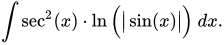
If we choose u(x) = ln(|sin(x)|) and v(x) = sec2x, then u differentiates to 1/ tan x using the chain rule and v integrates to tan x; so the formula gives:
- ∫sec2(x)⋅ln(|sin(x)|) dx=tan(x)⋅ln(|sin(x)|)−∫tan(x)⋅1tan(x)dx .{displaystyle int sec ^{2}(x)cdot ln {Big (}{bigl |}sin(x){bigr |}{Big )} dx=tan(x)cdot ln {Big (}{bigl |}sin(x){bigr |}{Big )}-int tan(x)cdot {frac {1}{tan(x)}}dx .}

The integrand simplifies to 1, so the antiderivative is x. Finding a simplifying combination frequently involves experimentation.
In some applications, it may not be necessary to ensure that the integral produced by integration by parts has a simple form; for example, in numerical analysis, it may suffice that it has small magnitude and so contributes only a small error term. Some other special techniques are demonstrated in the examples below.
Polynomials and trigonometric functions
In order to calculate
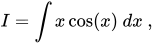
- I=∫xcos(x) dx ,{displaystyle I=int xcos(x) dx ,}
let:
- u=x ⇒ du=dx{displaystyle u=x Rightarrow du=dx}
- dv=cos(x) dx ⇒ v=∫cos(x) dx=sin(x){displaystyle dv=cos(x) dx Rightarrow v=int cos(x) dx=sin(x)}


then:
- ∫xcos(x) dx=∫u dv=u⋅v−∫vdu=xsin(x)−∫sin(x) dx=xsin(x)+cos(x)+C,{displaystyle {begin{aligned}int xcos(x) dx&=int u dv\&=ucdot v-int v,du\&=xsin(x)-int sin(x) dx\&=xsin(x)+cos(x)+C,end{aligned}}}
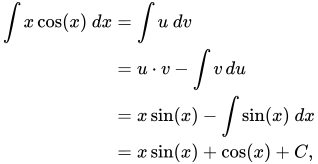
where C is a constant of integration.
For higher powers of x in the form
- ∫xnex dx, ∫xnsin(x) dx, ∫xncos(x) dx ,{displaystyle int x^{n}e^{x} dx, int x^{n}sin(x) dx, int x^{n}cos(x) dx ,}

repeatedly using integration by parts can evaluate integrals such as these; each application of the theorem lowers the power of x by one.
Exponentials and trigonometric functions
An example commonly used to examine the workings of integration by parts is
- I=∫excos(x) dx.{displaystyle I=int e^{x}cos(x) dx.}
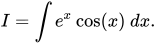
Here, integration by parts is performed twice. First let
- u=cos(x) ⇒ du=−sin(x) dx{displaystyle u=cos(x) Rightarrow du=-sin(x) dx}
- dv=ex dx ⇒ v=∫ex dx=ex{displaystyle dv=e^{x} dx Rightarrow v=int e^{x} dx=e^{x}}


then:
- ∫excos(x) dx=excos(x)+∫exsin(x) dx.{displaystyle int e^{x}cos(x) dx=e^{x}cos(x)+int e^{x}sin(x) dx.}

Now, to evaluate the remaining integral, we use integration by parts again, with:
- u=sin(x) ⇒ du=cos(x) dx{displaystyle u=sin(x) Rightarrow du=cos(x) dx}
- dv=ex dx ⇒ v=∫ex dx=ex.{displaystyle dv=e^{x} dx Rightarrow v=int e^{x} dx=e^{x}.}


Then:
- ∫exsin(x) dx=exsin(x)−∫excos(x) dx.{displaystyle int e^{x}sin(x) dx=e^{x}sin(x)-int e^{x}cos(x) dx.}

Putting these together,
- ∫excos(x) dx=excos(x)+exsin(x)−∫excos(x) dx.{displaystyle int e^{x}cos(x) dx=e^{x}cos(x)+e^{x}sin(x)-int e^{x}cos(x) dx.}

The same integral shows up on both sides of this equation. The integral can simply be added to both sides to get
- 2∫excos(x) dx=ex(sin(x)+cos(x))+C{displaystyle 2int e^{x}cos(x) dx=e^{x}{bigl (}sin(x)+cos(x){bigr )}+C}

which rearranges to:
- ∫excos(x) dx=ex(sin(x)+cos(x))2+C′{displaystyle int e^{x}cos(x) dx={frac {e^{x}{bigl (}sin(x)+cos(x){bigr )}}{2}}+C'}

where again C (and C' = C/2) is a constant of integration.
A similar method is used to find the integral of secant cubed.
Functions multiplied by unity
Two other well-known examples are when integration by parts is applied to a function expressed as a product of 1 and itself. This works if the derivative of the function is known, and the integral of this derivative times x is also known.
The first example is ∫ ln(x) dx. We write this as:
- I=∫ln(x)⋅1 dx .{displaystyle I=int ln(x)cdot 1 dx .}
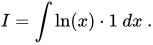
Let:
- u=ln(x) ⇒ du=dxx{displaystyle u=ln(x) Rightarrow du={frac {dx}{x}}}
- dv=dx ⇒ v=x{displaystyle dv=dx Rightarrow v=x}
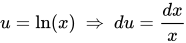

then:
- ∫ln(x) dx=xln(x)−∫xx dx=xln(x)−∫1 dx=xln(x)−x+C{displaystyle {begin{aligned}int ln(x) dx&=xln(x)-int {frac {x}{x}} dx\&=xln(x)-int 1 dx\&=xln(x)-x+Cend{aligned}}}
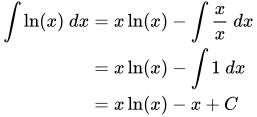
where C is the constant of integration.
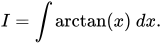
The second example is the inverse tangent function arctan(x):
- I=∫arctan(x) dx.{displaystyle I=int arctan(x) dx.}
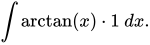
Rewrite this as
- ∫arctan(x)⋅1 dx.{displaystyle int arctan(x)cdot 1 dx.}
Now let:
- u=arctan(x) ⇒ du=dx1+x2{displaystyle u=arctan(x) Rightarrow du={frac {dx}{1+x^{2}}}}

- dv=dx ⇒ v=x{displaystyle dv=dx Rightarrow v=x}
then
- ∫arctan(x) dx=x⋅arctan(x)−∫x1+x2 dx=x⋅arctan(x)−ln(1+x2)2+C{displaystyle {begin{aligned}int arctan(x) dx&=xcdot arctan(x)-int {frac {x}{1+x^{2}}} dx\[8pt]&=xcdot arctan(x)-{frac {ln(1+x^{2})}{2}}+Cend{aligned}}}
![{displaystyle {begin{aligned}int arctan(x) dx&=xcdot arctan(x)-int {frac {x}{1+x^{2}}} dx\[8pt]&=xcdot arctan(x)-{frac {ln(1+x^{2})}{2}}+Cend{aligned}}}](https://wikimedia.org/api/rest_v1/media/math/render/svg/31bff76b6ab6c5c4479c0763538cea30654f54ec)
using a combination of the inverse chain rule method and the natural logarithm integral condition.
LIATE rule
A rule of thumb proposed by Herbert Kasube advises that whichever function comes first in the following list should be chosen as u:[4]
L – logarithmic functions: ln(x), logb(x),{displaystyle ln(x), log _{b}(x),}etc.
I – inverse trigonometric functions: arctan(x), arcsec(x),{displaystyle arctan(x), operatorname {arcsec}(x),}etc.
A – algebraic functions: x2, 3x50,{displaystyle x^{2}, 3x^{50},}etc.
T – trigonometric functions: sin(x), tan(x),{displaystyle sin(x), tan(x),}etc.
E – exponential functions: ex, 19x,{displaystyle e^{x}, 19^{x},}etc.
The function which is to be dv is whichever comes last in the list: functions lower on the list have easier antiderivatives than the functions above them. The rule is sometimes written as "DETAIL" where D stands for dv.
To demonstrate the LIATE rule, consider the integral
- ∫x⋅cos(x)dx.{displaystyle int xcdot cos(x),dx.}
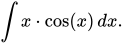
Following the LIATE rule, u = x, and dv = cos(x) dx, hence du = dx, and v = sin(x), which makes the integral become
- x⋅sin(x)−∫1sin(x)dx,{displaystyle xcdot sin(x)-int 1sin(x),dx,}

which equals
- x⋅sin(x)+cos(x)+C.{displaystyle xcdot sin(x)+cos(x)+C.}

In general, one tries to choose u and dv such that du is simpler than u and dv is easy to integrate. If instead cos(x) was chosen as u, and x dx as dv, we would have the integral
- x22cos(x)+∫x22sin(x)dx,{displaystyle {frac {x^{2}}{2}}cos(x)+int {frac {x^{2}}{2}}sin(x),dx,}
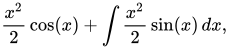
which, after recursive application of the integration by parts formula, would clearly result in an infinite recursion and lead nowhere.
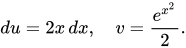
Although a useful rule of thumb, there are exceptions to the LIATE rule. A common alternative is to consider the rules in the "ILATE" order instead. Also, in some cases, polynomial terms need to be split in non-trivial ways. For example, to integrate
- ∫x3ex2dx,{displaystyle int x^{3}e^{x^{2}},dx,}

one would set
- u=x2,dv=x⋅ex2dx,{displaystyle u=x^{2},quad dv=xcdot e^{x^{2}},dx,}

so that
- du=2xdx,v=ex22.{displaystyle du=2x,dx,quad v={frac {e^{x^{2}}}{2}}.}
Then
- ∫x3ex2dx=∫(x2)(xex2)dx=∫udv=uv−∫vdu=x2ex22−∫xex2dx.{displaystyle int x^{3}e^{x^{2}},dx=int (x^{2})left(xe^{x^{2}}right),dx=int u,dv=uv-int v,du={frac {x^{2}e^{x^{2}}}{2}}-int xe^{x^{2}},dx.}

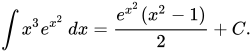
Finally, this results in
- ∫x3ex2dx=ex2(x2−1)2+C.{displaystyle int x^{3}e^{x^{2}},dx={frac {e^{x^{2}}(x^{2}-1)}{2}}+C.}
Integration by parts is often used as a tool to prove theorems in mathematical analysis.
Use in special functions
The gamma function is an example of a special function, defined as an improper integral for z > 0. Integration by parts illustrates it to be an extension of the factorial:
- Γ(z)=∫0∞e−xxz−1dx=−∫0∞xz−1d(e−x)=−[e−xxz−1]0∞+∫0∞e−xd(xz−1)=0+∫0∞(z−1)xz−2e−xdx=(z−1)Γ(z−1).{displaystyle {begin{aligned}Gamma (z)&=int _{0}^{infty }e^{-x}x^{z-1},dx\&=-int _{0}^{infty }x^{z-1},dleft(e^{-x}right)\&=-left[e^{-x}x^{z-1}right]_{0}^{infty }+int _{0}^{infty }e^{-x},dleft(x^{z-1}right)\&=0+int _{0}^{infty }left(z-1right)x^{z-2}e^{-x},dx\&=(z-1)Gamma (z-1).end{aligned}}}
![{displaystyle {begin{aligned}Gamma (z)&=int _{0}^{infty }e^{-x}x^{z-1},dx\&=-int _{0}^{infty }x^{z-1},dleft(e^{-x}right)\&=-left[e^{-x}x^{z-1}right]_{0}^{infty }+int _{0}^{infty }e^{-x},dleft(x^{z-1}right)\&=0+int _{0}^{infty }left(z-1right)x^{z-2}e^{-x},dx\&=(z-1)Gamma (z-1).end{aligned}}}](https://wikimedia.org/api/rest_v1/media/math/render/svg/a41a900cb1d3a82e25798d261fe5c7712b47c8a5)
Since
- Γ(1)=∫0∞e−xdx=1,{displaystyle Gamma (1)=int _{0}^{infty }e^{-x},dx=1,}
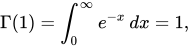
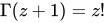
for integer z, applying this formula repeatedly gives the factorial (denoted by the !):
- Γ(z+1)=z!{displaystyle Gamma (z+1)=z!}
Use in harmonic analysis
Integration by parts is often used in harmonic analysis, particularly Fourier analysis, to show that quickly oscillating integrals with sufficiently smooth integrands decay quickly. The most common example of this is its use in showing that the decay of function's Fourier transform depends on the smoothness of that function, as described below.
Fourier transform of derivative
If f is a k-times continuously differentiable function and all derivatives up to the kth one decay to zero at infinity, then its Fourier transform satisfies
- (Ff(k))(ξ)=(2πiξ)kFf(ξ),{displaystyle ({mathcal {F}}f^{(k)})(xi )=(2pi ixi )^{k}{mathcal {F}}f(xi ),}

where f(k) is the kth derivative of f. (The exact constant on the right depends on the convention of the Fourier transform used.) This is proved by noting that
- ddye−2πiyξ=−2πiξe−2πiyξ,{displaystyle {frac {d}{dy}}e^{-2pi iyxi }=-2pi ixi e^{-2pi iyxi },}
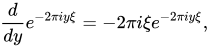
so using integration by parts on the Fourier transform of the derivative we get
- (Ff′)(ξ)=∫−∞∞e−2πiyξf′(y)dy=[e−2πiyξf(y)]−∞∞−∫−∞∞(−2πiξe−2πiyξ)f(y)dy=2πiξ∫−∞∞e−2πiyξf(y)dy=2πiξFf(ξ).{displaystyle {begin{aligned}({mathcal {F}}f')(xi )&=int _{-infty }^{infty }e^{-2pi iyxi }f'(y),dy\&=left[e^{-2pi iyxi }f(y)right]_{-infty }^{infty }-int _{-infty }^{infty }(-2pi ixi e^{-2pi iyxi })f(y),dy\&=2pi ixi int _{-infty }^{infty }e^{-2pi iyxi }f(y),dy\&=2pi ixi {mathcal {F}}f(xi ).end{aligned}}}
![{displaystyle {begin{aligned}({mathcal {F}}f')(xi )&=int _{-infty }^{infty }e^{-2pi iyxi }f'(y),dy\&=left[e^{-2pi iyxi }f(y)right]_{-infty }^{infty }-int _{-infty }^{infty }(-2pi ixi e^{-2pi iyxi })f(y),dy\&=2pi ixi int _{-infty }^{infty }e^{-2pi iyxi }f(y),dy\&=2pi ixi {mathcal {F}}f(xi ).end{aligned}}}](https://wikimedia.org/api/rest_v1/media/math/render/svg/6f0127883b4ccb7c4dfe1006f856417e0df79d40)
Applying this inductively gives the result for general k. A similar method can be used to find the Laplace transform of a derivative of a function.
Decay of Fourier transform
The above result tells us about the decay of the Fourier transform, since it follows that if f and f(k) are integrable then
|Ff(ξ)|≤I(f)1+|2πξ|k{displaystyle vert {mathcal {F}}f(xi )vert leq {frac {I(f)}{1+vert 2pi xi vert ^{k}}}}, where I(f)=∫−∞∞(|f(y)|+|f(k)(y)|)dy{displaystyle I(f)=int _{-infty }^{infty }{Bigl (}vert f(y)vert +vert f^{(k)}(y)vert {Bigr )}dy}
.
In other words, if f satisfies these conditions then its Fourier transform decays at infinity at least as quickly as 1/|ξ|k. In particular, if k ≥ 2 then the Fourier transform is integrable.
The proof uses the fact, which is immediate from the definition of the Fourier transform, that
- |Ff(ξ)|≤∫−∞∞|f(y)|dy.{displaystyle vert {mathcal {F}}f(xi )vert leq int _{-infty }^{infty }vert f(y)vert ,dy.}
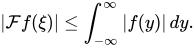
Using the same idea on the equality stated at the start of this subsection gives
- |(2πiξ)kFf(ξ)|≤∫−∞∞|f(k)(y)|dy.{displaystyle vert (2pi ixi )^{k}{mathcal {F}}f(xi )vert leq int _{-infty }^{infty }vert f^{(k)}(y)vert ,dy.}

Summing these two inequalities and then dividing by 1 + |2πξk| gives the stated inequality.
Use in operator theory
One use of integration by parts in operator theory is that it shows that the -∆ (where ∆ is the Laplace operator) is a positive operator on L2 (see Lp space). If f is smooth and compactly supported then, using integration by parts, we have
- ⟨−Δf,f⟩L2=−∫−∞∞f″(x)f(x)¯dx=−[f′(x)f(x)¯]−∞∞+∫−∞∞f′(x)f′(x)¯dx=∫−∞∞|f′(x)|2dx≥0.{displaystyle {begin{aligned}langle -Delta f,frangle _{L^{2}}&=-int _{-infty }^{infty }f''(x){overline {f(x)}},dx\&=-left[f'(x){overline {f(x)}}right]_{-infty }^{infty }+int _{-infty }^{infty }f'(x){overline {f'(x)}},dx\&=int _{-infty }^{infty }vert f'(x)vert ^{2},dxgeq 0.end{aligned}}}
![{begin{aligned}langle -Delta f,frangle _{L^{2}}&=-int _{-infty }^{infty }f''(x){overline {f(x)}},dx\&=-left[f'(x){overline {f(x)}}right]_{-infty }^{infty }+int _{-infty }^{infty }f'(x){overline {f'(x)}},dx\&=int _{-infty }^{infty }vert f'(x)vert ^{2},dxgeq 0.end{aligned}}](https://wikimedia.org/api/rest_v1/media/math/render/svg/be2f16d20e8aee1e1685201be627cee59643463e)
Other applications
- For determining boundary conditions in Sturm–Liouville theory
- Deriving the Euler–Lagrange equation in the calculus of variations
Repeated integration by parts
Considering a second derivative of v{displaystyle v}
- ∫uv″dx=uv′−∫u′v′dx=uv′−(u′v−∫u″vdx).{displaystyle int uv''dx=uv'-int u'v'dx=uv'-left(u'v-int u''vdxright).}

Extending this concept of repeated partial integration to derivatives of degree n leads to
- ∫u(0)v(n)dx=u(0)v(n−1)−u(1)v(n−2)+u(2)v(n−3)−⋯+(−1)n−1u(n−1)v(0)+(−1)n∫u(n)v(0)dx.{displaystyle int u^{(0)}v^{(n)}dx=u^{(0)}v^{(n-1)}-u^{(1)}v^{(n-2)}+u^{(2)}v^{(n-3)}-cdots +(-1)^{n-1}u^{(n-1)}v^{(0)}+(-1)^{n}int u^{(n)}v^{(0)}dx.}

This concept may be useful when the successive integrals of v(n){displaystyle v^{(n)}}


In the course of the above repetition of partial integrations the integrals
∫u(0)v(n)dx{displaystyle int u^{(0)}v^{(n)}dxquad }and ∫u(ℓ)v(n−ℓ)dx{displaystyle quad int u^{(ell )}v^{(n-ell )}dxquad }
and ∫u(m)v(n−m)dx for 1≤m,ℓ≤n{displaystyle quad int u^{(m)}v^{(n-m)}dxquad {text{ for }}1leq m,ell leq n}

get related. This may be interpreted as arbitrarily "shifting" derivatives between v{displaystyle v}
Tabular integration by parts
The essential process of the above formula can be summarized in a table; the resulting method is called "tabular integration"[5] and was featured in the film Stand and Deliver.[6]
For example, consider the integral
∫x3cosxdx{displaystyle int x^{3}cos x,dxquad }and take u(0)=x3,v(n)=cosx.{displaystyle quad u^{(0)}=x^{3},quad v^{(n)}=cos x.}

Begin to list in column A the function u(0)=x3{displaystyle u^{(0)}=x^{3}}


# i
Sign
A: derivatives u(i)
B: integrals v(n−i)
0
+
x3{displaystyle x^{3}}
cosx{displaystyle cos x}
1
−
3x2{displaystyle 3x^{2}}
sinx{displaystyle sin x}
2
+
6x{displaystyle 6x}
−cosx{displaystyle -cos x}
3
−
6{displaystyle 6}
−sinx{displaystyle -sin x}
4
+
0{displaystyle 0}
cosx{displaystyle cos x}


The product of the entries in row i of columns A and B together with the respective sign give the relevant integrals in step i in the course of repeated integration by parts. Step i = 0 yields the original integral. For the complete result in step i > 0 the ith integral must be added to all the previous products (0 ≤ j < i) of the jth entry of column A and the (j + 1)st entry of column B (i.e., multiply the 1st entry of column A with the 2nd entry of column B, the 2nd entry of column A with the 3rd entry of column B, etc ...) with the given jth sign. This process comes to a natural halt, when the product, which yields the integral, is zero (i = 4 in the example). The complete result is the following (notice the alternating signs in each term):
- (+1)(x3)(sinx)⏟j=0+(−1)(3x2)(−cosx)⏟j=1+(+1)(6x)(−sinx)⏟j=2+(−1)(6)(cosx)⏟j=3+∫(+1)(0)(cosx)dx⏟i=4:→C.{displaystyle underbrace {(+1)(x^{3})(sin x)} _{j=0}+underbrace {(-1)(3x^{2})(-cos x)} _{j=1}+underbrace {(+1)(6x)(-sin x)} _{j=2}+underbrace {(-1)(6)(cos x)} _{j=3}+underbrace {int (+1)(0)(cos x),dx} _{i=4:;to ;C}.}

This yields
- ∫x3cosxdx⏟step 0=x3sinx+3x2cosx−6xsinx−6cosx+C.{displaystyle underbrace {int x^{3}cos x,dx} _{text{step 0}}=x^{3}sin x+3x^{2}cos x-6xsin x-6cos x+C.}

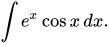
The repeated partial integration also turns out useful, when in the course of respectively differentiating and integrating the functions u(i){displaystyle u^{(i)}}
- ∫excosxdx.{displaystyle int e^{x}cos x,dx.}
# i
Sign
A: derivatives u(i)
B: integrals v(n−i)
0
+
ex{displaystyle e^{x}}
cosx{displaystyle cos x}
1
−
ex{displaystyle e^{x}}
sinx{displaystyle sin x}
2
+
ex{displaystyle e^{x}}
−cosx{displaystyle -cos x}

In this case the product of the terms in columns A and B with the appropriate sign for index i = 2 yields the negative of the original integrand (compare rows i = 0 and i = 2).
- ∫excosxdx⏟step 0=(+1)(ex)(sinx)⏟j=0+(−1)(ex)(−cosx)⏟j=1+∫(+1)(ex)(−cosx)dx⏟i=2.{displaystyle underbrace {int e^{x}cos x,dx} _{text{step 0}}=underbrace {(+1)(e^{x})(sin x)} _{j=0}+underbrace {(-1)(e^{x})(-cos x)} _{j=1}+underbrace {int (+1)(e^{x})(-cos x),dx} _{i=2}.}

Observing that the integral on the RHS can have its own constant of integration C′{displaystyle C'}
- 2∫excosxdx=exsinx+excosx+C′,{displaystyle 2int e^{x}cos x,dx=e^{x}sin x+e^{x}cos x+C',}

and finally:
- ∫excosxdx=12(ex(sinx+cosx))+C,{displaystyle int e^{x}cos x,dx={frac {1}{2}}left(e^{x}(sin x+cos x)right)+C,}

where C = C′/2.
Higher dimensions
The formula for integration by parts can be extended to functions of several variables. These derivations are analogous to the one given above: a fundamental theorem of calculus is substituted into an appropriate product rule. There are several such pairings possible in multivariate calculus.[7] For example, we may begin with a product rule for divergence followed by the divergence theorem.
A product rule for divergence:
- ∇⋅(φv→)=φ (∇⋅v→) + v→⋅(∇φ){displaystyle nabla cdot (varphi {vec {v}})=varphi (nabla cdot {vec {v}}) + {vec {v}}cdot (nabla varphi )}

Instead of an interval we integrate over an n-dimensional domain Ω{displaystyle Omega }
- ∫Ωφdivv→dV=∫Ω∇⋅(φv→)dV−∫Ωv→⋅gradφdV{displaystyle int _{Omega }varphi ,operatorname {div} {vec {v}},dV=int _{Omega }nabla cdot (varphi ,{vec {v}})dV-int _{Omega }{vec {v}}cdot operatorname {grad} varphi ,dV}

After substitution using the divergence theorem we arrive at:
- ∫Ωφdivv→dV=∫∂Ωφv→⋅dS→−∫Ωv→⋅gradφdV.{displaystyle int _{Omega }varphi ,operatorname {div} {vec {v}},dV=int _{partial Omega }varphi ,{vec {v}}cdot d{vec {S}}-int _{Omega }{vec {v}}cdot operatorname {grad} varphi ,dV.}

More specifically, suppose Ω is an open bounded subset of ℝn with a piecewise smooth boundary Γ. If u and v are two continuously differentiable functions on the closure of Ω, then the formula for integration by parts is
- ∫Ω∂u∂xivdΩ=∫Γuvν^idΓ−∫Ωu∂v∂xidΩ,{displaystyle int _{Omega }{frac {partial u}{partial x_{i}}}v,dOmega =int _{Gamma }uv,{hat {nu }}_{i},dGamma -int _{Omega }u{frac {partial v}{partial x_{i}}},dOmega ,}

where ν^{displaystyle {hat {mathbf {nu } }}}

- ∫Ωv∇udΩ=∫Γuvν^dΓ−∫Ωu∇vdΩ,{displaystyle int _{Omega }vnabla u,dOmega =int _{Gamma }uv,mathbf {hat {nu }} ,dGamma -int _{Omega }unabla v,dOmega ,}

Replacing v in the component formula with vi and summing over i gives the vector formula
- ∫Ω∇u⋅vdΩ=∫Γu(v⋅ν^)dΓ−∫Ωu∇⋅vdΩ,{displaystyle int _{Omega }nabla ucdot mathbf {v} ,dOmega =int _{Gamma }u(mathbf {v} cdot {hat {nu }}),dGamma -int _{Omega }u,nabla cdot mathbf {v} ,dOmega ,}

where v is a vector-valued function with components v1, ..., vn.
For v=∇v{displaystyle mathbf {v} =nabla v}

- ∫Ω∇u⋅∇vdΩ=∫Γu∇v⋅ν^dΓ−∫Ωu∇2vdΩ,{displaystyle int _{Omega }nabla ucdot nabla v,dOmega =int _{Gamma }u,nabla vcdot {hat {nu }},dGamma -int _{Omega }u,nabla ^{2}v,dOmega ,}

which is the first Green's identity.
The regularity requirements of the theorem can be relaxed. For instance, the boundary Γ need only be Lipschitz continuous. In the first formula above, only u, v ∈ H1(Ω) is necessary (where H1 is a Sobolev space); the other formulas have similarly relaxed requirements.
See also
- Integration by parts for the Lebesgue–Stieltjes integral
Integration by parts for semimartingales, involving their quadratic covariation.- Integration by substitution
- Legendre transformation
Notes
^ "Brook Taylor". History.MCS.St-Andrews.ac.uk. Retrieved May 25, 2018..mw-parser-output cite.citation{font-style:inherit}.mw-parser-output q{quotes:"""""""'""'"}.mw-parser-output code.cs1-code{color:inherit;background:inherit;border:inherit;padding:inherit}.mw-parser-output .cs1-lock-free a{background:url("//upload.wikimedia.org/wikipedia/commons/thumb/6/65/Lock-green.svg/9px-Lock-green.svg.png")no-repeat;background-position:right .1em center}.mw-parser-output .cs1-lock-limited a,.mw-parser-output .cs1-lock-registration a{background:url("//upload.wikimedia.org/wikipedia/commons/thumb/d/d6/Lock-gray-alt-2.svg/9px-Lock-gray-alt-2.svg.png")no-repeat;background-position:right .1em center}.mw-parser-output .cs1-lock-subscription a{background:url("//upload.wikimedia.org/wikipedia/commons/thumb/a/aa/Lock-red-alt-2.svg/9px-Lock-red-alt-2.svg.png")no-repeat;background-position:right .1em center}.mw-parser-output .cs1-subscription,.mw-parser-output .cs1-registration{color:#555}.mw-parser-output .cs1-subscription span,.mw-parser-output .cs1-registration span{border-bottom:1px dotted;cursor:help}.mw-parser-output .cs1-hidden-error{display:none;font-size:100%}.mw-parser-output .cs1-visible-error{font-size:100%}.mw-parser-output .cs1-subscription,.mw-parser-output .cs1-registration,.mw-parser-output .cs1-format{font-size:95%}.mw-parser-output .cs1-kern-left,.mw-parser-output .cs1-kern-wl-left{padding-left:0.2em}.mw-parser-output .cs1-kern-right,.mw-parser-output .cs1-kern-wl-right{padding-right:0.2em}
^ "Brook Taylor". Stetson.edu. Retrieved May 25, 2018.
^ "Integration by parts". Encyclopedia of Mathematics.
^ Kasube, Herbert E. (1983). "A Technique for Integration by Parts". The American Mathematical Monthly. 90 (3): 210–211. doi:10.2307/2975556. JSTOR 2975556.
^ Khattri, Sanjay K. (2008). "FOURIER SERIES AND LAPLACE TRANSFORM THROUGH TABULAR INTEGRATION" (PDF). The Teaching of Mathematics. XI (2): 97–103.
^ Horowitz, David (1990). "Tabular Integration by Parts" (PDF). The College Mathematics Journal. 21 (4): 307–311. doi:10.2307/2686368. JSTOR 2686368.
^ Rogers, Robert C. (September 29, 2011). "The Calculus of Several Variables" (PDF).
References
Evans, Lawrence C. (1998). Partial Differential Equations. Providence, Rhode Island: American Mathematical Society. ISBN 0-8218-0772-2.
Arbogast, Todd; Bona, Jerry (2005). Methods of Applied Mathematics (PDF).
Horowitz, David (September 1990). "Tabular Integration by Parts". The College Mathematics Journal. 21 (4): 307–311. doi:10.2307/2686368. JSTOR 2686368.
External links
 | The Wikibook Calculus has a page on the topic of: Integration by parts |
Hazewinkel, Michiel, ed. (2001) [1994], "Integration by parts", Encyclopedia of Mathematics, Springer Science+Business Media B.V. / Kluwer Academic Publishers, ISBN 978-1-55608-010-4
- Integration by parts—from MathWorld


