Oranienburg
Oranienburg | ||
|---|---|---|
 Schloss Oranienburg | ||
| ||
Location of Oranienburg | ||
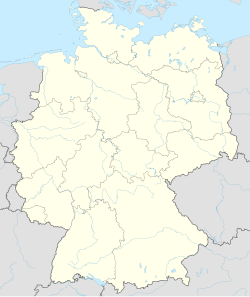  Oranienburg Show map of Germany 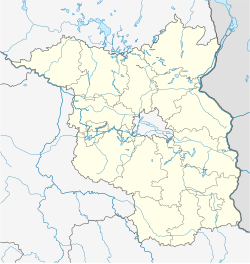 Oranienburg Show map of Brandenburg | ||
| Coordinates: 52°45′16″N 13°14′13″E / 52.75444°N 13.23694°E / 52.75444; 13.23694Coordinates: 52°45′16″N 13°14′13″E / 52.75444°N 13.23694°E / 52.75444; 13.23694 | ||
| Country | Germany | |
| State | Brandenburg | |
| District | Oberhavel | |
| Government | ||
| • Mayor | Hans-Joachim Laesicke (SPD) | |
| Area | ||
| • Total | 162.37 km2 (62.69 sq mi) | |
| Elevation | 34 m (112 ft) | |
| Population (2017-12-31)[1] | ||
| • Total | 43,982 | |
| • Density | 270/km2 (700/sq mi) | |
| Time zone | CET/CEST (UTC+1/+2) | |
| Postal codes | 16515 | |
| Dialling codes | 03301 | |
| Vehicle registration | OHV | |
| Website | www.oranienburg.de | |

Oranienburg is a town in Brandenburg, Germany. It is the capital of the district of Oberhavel.
Contents
1 Geography
1.1 Division of the town
2 History
3 International relations
4 Public institutions
5 Transportation
6 See also
7 Demography
7.1 Sons and daughters of the city
8 Footnotes
9 External links
Geography
Oranienburg is a town located on the banks of the Havel river, 35 km north of the centre of Berlin.
Division of the town
Oranienburg consists of 9 districts
- Friedrichsthal
- Germendorf
- Lehnitz
- Malz
- Oranienburg
- Sachsenhausen
- Schmachtenhagen
- Wensickendorf
- Zehlendorf
History
Originally named Bötzow, the town of Oranienburg dates from the 12th century and was first mentioned in 1216. Margrave Albert the Bear (ruled 1157-1170) allegedly ordered the construction of a castle on the banks of the Havel. Around the castle stood a settlement of traders and craftsmen.
In 1646 Friedrich Wilhelm I of Brandenburg married Louise Henriette of Orange-Nassau (German: Oranien-Nassau). She was so attracted by the town of Bötzow that her husband presented the entire region to her. The princess ordered the construction of a new castle in the Dutch style and called it Oranienburg or Schloss Oranienburg. In 1653 the town of Bötzow was renamed Oranienburg.
Silvio Gesell, the founder of Freiwirtschaft ("free economy"), lived in Oranienburg between 1911 and 1915, publishing his magazine, Der Physiocrat. He returned to the town in 1927 and lived there until his death in 1930. The town remained a center of the "free economy" movement until the Nazi régime outlawed it in 1933, and many of Gesell's followers ended up as prisoners in the town's concentration camp.[citation needed]
The Oranienburg concentration camp (established in March 1933) was one of the first Nazi concentration camps. In 1936 the Sachsenhausen concentration camp on the outskirts of Oranienburg replaced it; there 200,000 people were interned over the 9 years that the Nazis operated it. The Nazis murdered about 22,000 people there[citation needed] before the liberation of the camp by the Soviet Red Army in 1945. Thereafter the site reopened in August 1945 as "Soviet Special Camp 7". A further 12,000 people (mostly Nazis not awaiting trial) died under the Soviets before the Special Camp closed in 1950. Their remains were not discovered until the 1990s.[citation needed]
Oranienburg became the center of Nazi Germany's nuclear-energy project; the town also had an armaments hub, aircraft plant, and railway junction, all of military importance. According to military historian Antony Beevor, Stalin's desire to acquire the nuclear facility motivated him to launch the Battle for Berlin[2] of April-May 1945. It has been claimed[by whom?] that the pre-emptive destruction of these facilities by the USAAF Eighth Air Force on 15 March 1945 aimed to prevent them from falling into Soviet hands.[3]
On 23 April 1945, during the Battle of Berlin, troops of the 1st Belorussian Front of the Red Army captured Oranienburg.
Due to its heavy bombing, Oranienburg is the "most dangerous town in Germany"; it is the only city in Germany which pursues a systematic search for unexploded ordnance (UXO) based on postwar aerial photos and magnetic or radar underground measurements for metal. By 2017 about 200 had been disposed of, and 350 to 400 were estimated to remain.[4] It is estimated[by whom?] that the search and disposal will continue throughout the rest of the century. In one case 12,000 residents had to be evacuated. The federal government does not finance the removal of foreign UXO.[5][need quotation to verify]
International relations
Oranienburg is twinned with:
 Bagnolet (France) -- since 1964
 Hamm (North Rhine-Westphalia, Germany) -- since 1990
 Mělník (Czech Republic) -- since 1974
 Vught (Netherlands) -- since 2000
Friedrichsthal (Saarland, Germany) -- since 1991
 Bagnolet (France) -- since 1964
 Hamm (North Rhine-Westphalia, Germany) -- since 1990
 Mělník (Czech Republic) -- since 1974
 Vught (Netherlands) -- since 2000
Public institutions
The Zehlendorf transmission facility, a large facility for broadcasting in longwave, medium wave and FM-range, is located near Oranienburg, at Zehlendorf.

Runge plaque
Transportation
The city is served by the Berlin Northern Railway and provide a direct connection to Rostock.
See also
- Oranienburg railway station
- Stellwerk Fichtengrund
Demography
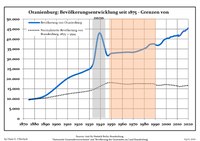
Development of Population since 1875 within the Current Boundaries (Blue Line: Population; Dotted Line: Comparison to Population Development of Brandenburg state; Grey background: Time of Nazi rule; Red background: Time of communist rule)
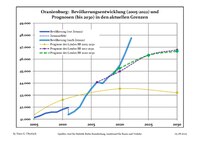
Recent Population Development (Blue Line) and Forecasts
| Oranienburg: Population development within the current boundaries (2013)[6] | ||||||||||||||||||||||||||||||||||||||||||||||||||||||||||||||||||||||||||||||||||||||||||||||||||||||||||||||||||||||||||||||||||||||
|---|---|---|---|---|---|---|---|---|---|---|---|---|---|---|---|---|---|---|---|---|---|---|---|---|---|---|---|---|---|---|---|---|---|---|---|---|---|---|---|---|---|---|---|---|---|---|---|---|---|---|---|---|---|---|---|---|---|---|---|---|---|---|---|---|---|---|---|---|---|---|---|---|---|---|---|---|---|---|---|---|---|---|---|---|---|---|---|---|---|---|---|---|---|---|---|---|---|---|---|---|---|---|---|---|---|---|---|---|---|---|---|---|---|---|---|---|---|---|---|---|---|---|---|---|---|---|---|---|---|---|---|---|---|---|
|
|
| ||||||||||||||||||||||||||||||||||||||||||||||||||||||||||||||||||||||||||||||||||||||||||||||||||||||||||||||||||||||||||||||||||||
Sons and daughters of the city

Friedrich Ludwig Dulon
Friedrich Ludwig Dulon, flutist and composer (1769-1826)
Walther Bothe, physicist and Nobel laureate (1891-1957)
Carl Gustav Hempel, Philosopher (1905-1997)
W. Michael Blumenthal, US Treasury, Director of the Jewish Museum Berlin (born 1926)
Bernd Eichwurzel, rower, Olympic champion 1988 (born 1964)
Alexander Walke, footballer (born 1983)
Marcus Mlynikowski, footballer (born 1992)
Footnotes
^ "Bevölkerung im Land Brandenburg nach amtsfreien Gemeinden, Ämtern und Gemeinden 31. Dezember 2017 (Fortgeschriebene amtliche Einwohnerzahlen auf Grundlage des Zensus 2011)". Amt für Statistik Berlin-Brandenburg (in German). 2018..mw-parser-output cite.citation{font-style:inherit}.mw-parser-output q{quotes:"""""""'""'"}.mw-parser-output code.cs1-code{color:inherit;background:inherit;border:inherit;padding:inherit}.mw-parser-output .cs1-lock-free a{background:url("//upload.wikimedia.org/wikipedia/commons/thumb/6/65/Lock-green.svg/9px-Lock-green.svg.png")no-repeat;background-position:right .1em center}.mw-parser-output .cs1-lock-limited a,.mw-parser-output .cs1-lock-registration a{background:url("//upload.wikimedia.org/wikipedia/commons/thumb/d/d6/Lock-gray-alt-2.svg/9px-Lock-gray-alt-2.svg.png")no-repeat;background-position:right .1em center}.mw-parser-output .cs1-lock-subscription a{background:url("//upload.wikimedia.org/wikipedia/commons/thumb/a/aa/Lock-red-alt-2.svg/9px-Lock-red-alt-2.svg.png")no-repeat;background-position:right .1em center}.mw-parser-output .cs1-subscription,.mw-parser-output .cs1-registration{color:#555}.mw-parser-output .cs1-subscription span,.mw-parser-output .cs1-registration span{border-bottom:1px dotted;cursor:help}.mw-parser-output .cs1-hidden-error{display:none;font-size:100%}.mw-parser-output .cs1-visible-error{font-size:100%}.mw-parser-output .cs1-subscription,.mw-parser-output .cs1-registration,.mw-parser-output .cs1-format{font-size:95%}.mw-parser-output .cs1-kern-left,.mw-parser-output .cs1-kern-wl-left{padding-left:0.2em}.mw-parser-output .cs1-kern-right,.mw-parser-output .cs1-kern-wl-right{padding-right:0.2em}
^ Antony Beevor Berlin: The Downfall 1945, Penguin Books, 2002,
ISBN 0-670-88695-5 Preface xxxiv
^ Richard G. Davis,Bombing the European Axis Powers. A Historical Digest of the Combined Bomber Offensive 1939–1945. Alabama: Air University Press, 2006, page 518
^ "Frankfurt WW2 bomb: Mass evacuation completed". BBC News. 3 September 2017. Retrieved 3 September 2017.
^
Rundfunk Berlin-Brandenburg (10 March 2015). "Bombenjäger". ARD.de. Retrieved 12 March 2015.
^ Detailed data sources are to be found in the Wikimedia Commons.Population Projection Brandenburg at Wikimedia Commons
External links
 Media related to Oranienburg at Wikimedia Commons
Official website (in German)
Towns and municipalities in Oberhavel | ||
|---|---|---|
|  | |
Authority control  |
|
|---|


