Saga (city)
 | This article includes a list of references, but its sources remain unclear because it has insufficient inline citations. (November 2018) (Learn how and when to remove this template message) |
Saga .mw-parser-output .nobold{font-weight:normal} 佐賀市 | |||
|---|---|---|---|
Special city | |||
| Saga City | |||
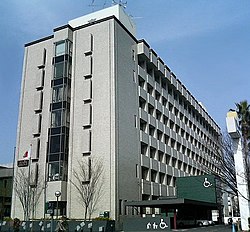 Saga City Hall | |||
| |||
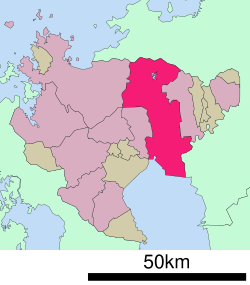 Location of Saga in Saga Prefecture | |||
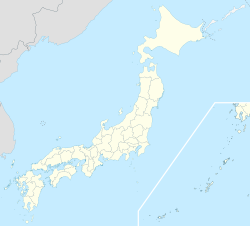  Saga Location of Saga in Saga Prefecture | |||
| Coordinates: 33°16′0″N 130°18′0″E / 33.26667°N 130.30000°E / 33.26667; 130.30000Coordinates: 33°16′0″N 130°18′0″E / 33.26667°N 130.30000°E / 33.26667; 130.30000 | |||
| Country | Japan | ||
| Region | Kyushu | ||
| Prefecture | Saga Prefecture | ||
| Government | |||
| • Mayor | Toshiyuki Hideshima | ||
| Area | |||
| • Land | 431.42 km2 (166.57 sq mi) | ||
| Population (February 28, 2017) | |||
| • Total | 234,453 | ||
| • Density | 543/km2 (209/sq mi) | ||
| Time zone | UTC+9 (Japan Standard Time) | ||
| - Tree | Ginkgo | ||
| - Flower | Cherry blossom (sakura) | ||
| Website | www.city.saga.lg.jp | ||


Saga (佐賀市, Saga-shi, Japanese: [saꜜɡa]) is the capital city of Saga Prefecture, located on the island of Kyushu, Japan.
Saga was the capital of Saga Domain in the Edo period, and largest city of former Hizen Province.
As of February 28, 2017, the city has an estimated population of 234,453 and a population density of 543 persons per km².[1] The total area is 431.84 km².
On October 1, 2005, Saga absorbed the towns of Fuji, Morodomi and Yamato (all from Saga District) and the village of Mitsuse (from Kanzaki District) to create the new and expanded city of Saga. With this creation, the city now neighbors the city of Fukuoka (in Fukuoka Prefecture).
On October 1, 2007 the towns of Higashiyoka, Kawasoe, and Kubota (all from Saga District) were also incorporated into Saga, further expanding its borders.
Although Saga is the capital of Saga Prefecture, it can also be said to be within the Greater Fukuoka metropolitan area, and by extension, Fukuoka-Kitakyushu Metropolitan Area.
Contents
1 History
1.1 Municipal timeline
1.2 Saga Castle
2 Geography
2.1 Climate
2.2 Adjoining municipalities
3 Education
3.1 Universities
3.2 Senior High Schools
4 Transportation
4.1 Air
4.2 Rail
4.3 Road
5 Attractions
6 Famous People from Saga
7 Sister cities
8 References
9 External links
History
Municipal timeline
- April 1, 1889 - The modern municipal system was established and the city of Saga is founded. At the same time, the current city region is occupied by 21 villages from three districts.
Kanzaki District: Hasuike and Mitsuse.
Ogi District: Kitayama and Nanzan.
Saga District: Higashikawasoe, Honjō, Hyōgo, Kamino, Kase, Kasuga, Kawakami, Kinryū, Kitakawasoe, Kose, Kuboizumi, Matsuume, Nabeshima, Nikita, Nishiyoka, Oseki and Takakise.
- June 6, 1899 - Kose changed the kanji of its name.
- October 1, 1922 - Kamino was incorporated into Saga.
- November 3, 1935 - Hasuike was elevated to town status.
- March 31, 1954 - Hyōgo, Kase, Kose, Nishiyoka and Takakise were all incorporated into Saga.
- October 1, 1954 - Honjō, Kinryū, Kitakawasoe, Kuboizumi and Nabeshima were all incorporated into Saga.
- March 1, 1955 - Higashikawasoe and Nikita were merged to create the town of Morodomi.
- October 1, 2005 - The towns of Fuji, Morodomi and Yamato (all from Saga District) and the village of Mitsuse (from Kanzaki District) merged with Saga. (population: 206,967 ; area: 355.15 km²)
- October 1, 2007 - The towns of Higashiyoka, Kawasoe, and Kubota (all from Saga District) were all incorporated into Saga. (population: roughly 240,000 ; area: 431.42 km²) Saga District was dissolved as a result of this merger.
Saga Castle
Standing out from many cultural assets is the plains castle within the city, Saga Castle. It is one of the rare castles in Japan surrounded by a wall rather than built on one. First built between 1591 and 1593, there was a fire in 1726. Renovated in 1728, there was yet another fire in 1835. Nabeshima Naomasa, daimyō of the Nabeshima clan, renovated it within two years and moved in. In 1874 it was a court building and a prefectural office. 1883 saw it become a junior school. The buildings were eventually replaced by modern school buildings.
Geography
Saga City is located in the southeast portion of Saga Prefecture. After the 2005 merger the city became very long north to south. It now borders the Ariake Sea to the south and Fukuoka Prefecture to the southeast and north. The northern half of the city contains the Sefuri Mountains.
Climate
Saga has a humid subtropical climate (Köppen climate classification Cfa).The annual average precipitation ranges from about 1800 mm (71 in) in the city center to about 2400 mm (94 in) in Mitsuse. The annual average temperature ranges from about 13 °C (55 °F) in Mitsuse to 17 °C (63 °F) in the city center.
| Climate data for Saga, Saga | |||||||||||||
|---|---|---|---|---|---|---|---|---|---|---|---|---|---|
| Month | Jan | Feb | Mar | Apr | May | Jun | Jul | Aug | Sep | Oct | Nov | Dec | Year |
| Average high °C (°F) | 9.5 (49.1) | 10.6 (51.1) | 14.6 (58.3) | 20.3 (68.5) | 24.8 (76.6) | 27.4 (81.3) | 30.9 (87.6) | 32.4 (90.3) | 28.6 (83.5) | 23.5 (74.3) | 17.7 (63.9) | 12.1 (53.8) | 21.0 (69.9) |
| Daily mean °C (°F) | 5.0 (41.0) | 6.0 (42.8) | 9.3 (48.7) | 14.8 (58.6) | 19.2 (66.6) | 22.8 (73.0) | 26.8 (80.2) | 27.6 (81.7) | 23.7 (74.7) | 17.9 (64.2) | 12.4 (54.3) | 7.2 (45.0) | 16.1 (60.9) |
| Average low °C (°F) | 1.2 (34.2) | 2.0 (35.6) | 4.7 (40.5) | 10.0 (50.0) | 14.3 (57.7) | 18.9 (66.0) | 23.6 (74.5) | 23.9 (75.0) | 19.9 (67.8) | 13.3 (55.9) | 7.9 (46.2) | 3.1 (37.6) | 11.9 (53.4) |
| Average precipitation mm (inches) | 62.0 (2.44) | 73.5 (2.89) | 113.7 (4.48) | 171.3 (6.74) | 190.0 (7.48) | 321.6 (12.66) | 341.4 (13.44) | 178.2 (7.02) | 175.0 (6.89) | 96.8 (3.81) | 68.5 (2.70) | 44.4 (1.75) | 1,836.4 (72.3) |
| Average snowfall cm (inches) | 6 (2.4) | 5 (2.0) | 0 (0) | 0 (0) | 0 (0) | 0 (0) | 0 (0) | 0 (0) | 0 (0) | 0 (0) | 0 (0) | 1 (0.4) | 12 (4.8) |
| Average relative humidity (%) | 71 | 70 | 68 | 70 | 71 | 76 | 80 | 77 | 76 | 72 | 72 | 73 | 73 |
| Mean monthly sunshine hours | 117.5 | 120.6 | 160.9 | 161.7 | 182.5 | 143.7 | 169.4 | 210.1 | 164.4 | 174.2 | 141.4 | 123.1 | 1,869.5 |
| Source: NOAA (1961-1990)[2] | |||||||||||||
Adjoining municipalities

Saga city center
Saga Prefecture
- Kanzaki
- Karatsu
- Ogi
- Taku
Fukuoka Prefecture
Fukuoka
- Sawara-ku, Fukuoka
- Itoshima
- Ōkawa
- Yanagawa
Education

Saga city office
Universities
|
|
Senior High Schools
|
|
Transportation
Air
There is one airport inside the city of Saga, Saga Airport, located in the former town of Kawasoe. Before the opening of Saga Airport, Fukuoka Airport was the nearest airport. However, many people in Saga still use Fukuoka Airport due its greater number of routes and flights offered. There is an express bus which connects the two airports.
Rail

The south exit of Saga Station
JR Kyushu
Nagasaki Main Line
Igaya Station - Saga Station - Nabeshima Station - Balloon Saga Station (only in operation during the Saga International Balloon Fiesta) - Kubota Station
Karatsu Line
- Kubota Station
Road
Expressways
Nagasaki Expressway
- Interchanges: Saga Yamato Interchange
- Other facilities: Kinryū Service Area
National highways
Route 34 ("Hokubu Bypass")- Route 207
Route 208 ("Nambu Bypass")
Route 263
- Toll section: Mitsuse Tunnel
- Yamato Roadside Station
- Route 264
- Route 323
- Route 444
Attractions
Every fall Saga holds the "Saga International Balloon Fiesta" in the dry riverbed of the Kase River. A quarter of the visitors are from Saga. The number of visitors was about 15 million in 2005. Hot air balloonists from many countries enter this event.
Kakurintei Tea House located in the grounds of Kono Koen is a very quaint and picturesque Japanese tea house overlooking a pond.
Saga Castle (Also called the Saga Castle Historical Museum) is the largest reconstruction of a wooden building in Japan, with a total floor space of 2500 square meters and the historical atmosphere of the Saga Castle main keep.
Famous People from Saga
Shigeo Shingo, an industrial engineer who distinguished himself as one of the world’s leading experts on manufacturing practices.
Hidenori Chiwata, a singer whose song カサブタ (Kasabuta / "Scab") was used as a theme song in the anime Zatch Bell!.
Hanawa, singer and comedian. He released a CD about Saga city
Yasuko Matsuyuki, singer and actress known for her glamorous and sophisticated personality. She is mentioned in Hanawa's song as being one of the celebrities that won't admit being from Saga. She moved away from Saga at the age of 19 to be a model.- Yuna Katsuki (born Yohei Matsuyuki), singer and musician, of Lazy Knack, RED, The Flare, and Candelars, and also the younger brother of Yasuko Matsuyuki. He freely admits being from Saga, unlike his sister. Yuna's Official Website He moved to Tokyo at the age of 16.
Egashira 2:50, a comedian
Noriko Nakagoshi, an actress
Ikumi Yoshimatsu, Miss International 2012
Rikako Sakata, actress known for Miu Kazashiro in Kamen Rider Fourze
Sister cities
 Warren County, New York and Glens Falls, New York, United States
 Yeonje-gu, Busan, South korea
 Lianyungang, Jiangsu, China
 Limeira, São Paulo, Brazil


References
^ https://www.city.saga.lg.jp/
^ "Saga Climate Normals 1961-1990". National Oceanic and Atmospheric Administration. Retrieved January 6, 2013..mw-parser-output cite.citation{font-style:inherit}.mw-parser-output .citation q{quotes:"""""""'""'"}.mw-parser-output .citation .cs1-lock-free a{background:url("//upload.wikimedia.org/wikipedia/commons/thumb/6/65/Lock-green.svg/9px-Lock-green.svg.png")no-repeat;background-position:right .1em center}.mw-parser-output .citation .cs1-lock-limited a,.mw-parser-output .citation .cs1-lock-registration a{background:url("//upload.wikimedia.org/wikipedia/commons/thumb/d/d6/Lock-gray-alt-2.svg/9px-Lock-gray-alt-2.svg.png")no-repeat;background-position:right .1em center}.mw-parser-output .citation .cs1-lock-subscription a{background:url("//upload.wikimedia.org/wikipedia/commons/thumb/a/aa/Lock-red-alt-2.svg/9px-Lock-red-alt-2.svg.png")no-repeat;background-position:right .1em center}.mw-parser-output .cs1-subscription,.mw-parser-output .cs1-registration{color:#555}.mw-parser-output .cs1-subscription span,.mw-parser-output .cs1-registration span{border-bottom:1px dotted;cursor:help}.mw-parser-output .cs1-ws-icon a{background:url("//upload.wikimedia.org/wikipedia/commons/thumb/4/4c/Wikisource-logo.svg/12px-Wikisource-logo.svg.png")no-repeat;background-position:right .1em center}.mw-parser-output code.cs1-code{color:inherit;background:inherit;border:inherit;padding:inherit}.mw-parser-output .cs1-hidden-error{display:none;font-size:100%}.mw-parser-output .cs1-visible-error{font-size:100%}.mw-parser-output .cs1-maint{display:none;color:#33aa33;margin-left:0.3em}.mw-parser-output .cs1-subscription,.mw-parser-output .cs1-registration,.mw-parser-output .cs1-format{font-size:95%}.mw-parser-output .cs1-kern-left,.mw-parser-output .cs1-kern-wl-left{padding-left:0.2em}.mw-parser-output .cs1-kern-right,.mw-parser-output .cs1-kern-wl-right{padding-right:0.2em}
External links
 | Wikivoyage has a travel guide for Saga. |
 | Wikimedia Commons has media related to Saga, Saga. |
Saga City official website (in Japanese)
Saga City official website (in English)
About the Hagakure the Castle (in English)
Saga International Balloon Fiesta (in English)
 Saga Prefecture Saga Prefecture | ||
|---|---|---|
Saga (capital) | ||
| Special city |
|  |
| Cities |
| |
| Districts |
| |
List of mergers in Saga Prefecture | ||
 Japan cities with a 200,000+ population Japan cities with a 200,000+ population | |
|---|---|
| 2,000,000 and more |
|
| 1,000,000–1,999,999 |
|
| 500,000–999,999 |
|
| 200,000–499,999 |
|
Authority control  |
|
|---|


