Spectrum (topology)
In algebraic topology, a branch of mathematics, a spectrum is an object representing a generalized cohomology theory. There are several different categories of spectra, but they all determine the same homotopy category, known as the stable homotopy category.
Contents
1 The definition of a spectrum
2 Examples
3 Invariants
4 Functions, maps, and homotopies of spectra
5 The triangulated homotopy category of spectra
6 Smash products of spectra
7 Generalized homology and cohomology of spectra
8 History
9 See also
10 References
11 External links
The definition of a spectrum
There are many variations of the definition: in general, a spectrum is any sequence Xn{displaystyle X_{n}}

The treatment here is due to Frank Adams (1974): a spectrum (or CW-spectrum) is a sequence E:={En}n∈N{displaystyle E:={E_{n}}_{nin mathbb {N} }}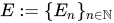



For other definitions, see symmetric spectrum and simplicial spectrum.
Examples
Consider singular cohomology Hn(X;A){displaystyle H^{n}(X;A)}

As a second important example, consider topological K-theory. At least for X compact, K0(X){displaystyle K^{0}(X)}




For many more examples, see the list of cohomology theories.
- A spectrum may be constructed out of a space. The suspension spectrum of a space X is a spectrum Xn=Sn∧X{displaystyle X_{n}=S^{n}wedge X}
(the structure maps are the identity.) For example, the suspension spectrum of the 0-sphere is called the sphere spectrum and is denoted by S{displaystyle mathbb {S} }
.
- An Ω-spectrum is a spectrum such that the adjoint of the structure map (Xn→ΩXn+1{displaystyle X_{n}to Omega X_{n+1}}
) is a weak equivalence. The K-theory spectrum of a ring is an example of an Ω-spectrum.
- A ring spectrum is a spectrum X such that the diagrams that describe ring axioms in terms of smash products commute "up to homotopy" (S0→X{displaystyle S^{0}to X}
corresponds to the identity.) For example, the spectrum of topological K-theory is a ring spectrum. A module spectrum may be defined analogously.
Invariants
- The homotopy group of a spectrum Xn{displaystyle X_{n}}
. Thus, for example, πk(S){displaystyle pi _{k}(mathbb {S} )}
, S{displaystyle mathbb {S} }
are zero for negative k.
Functions, maps, and homotopies of spectra
There are three natural categories whose objects are spectra, whose morphisms are the functions, or maps, or homotopy classes defined below.
A function between two spectra E and F is a sequence of maps from En to Fn that commute with the
maps ΣEn → En+1 and ΣFn → Fn+1.
Given a spectrum En{displaystyle E_{n}}


This gives the category of spectra (and maps), which is a major tool. There is a natural embedding of the category of pointed CW complexes into this category: it takes Y{displaystyle Y}

The smash product of a spectrum E{displaystyle E}

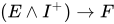

![[0,1]sqcup {*}](https://wikimedia.org/api/rest_v1/media/math/render/svg/65a88e779b78b22013966fb634d01af46a1418fc)

The stable homotopy category, or homotopy category of (CW) spectra is defined to be the category whose objects are spectra and whose morphisms are homotopy classes of maps between spectra. Many other definitions of spectrum, some appearing very different, lead to equivalent stable homotopy categories.
Finally, we can define the suspension of a spectrum by (ΣE)n=En+1{displaystyle (Sigma E)_{n}=E_{n+1}}

The triangulated homotopy category of spectra
The stable homotopy category is additive: maps can be added by using a variant of the track addition used to define homotopy groups. Thus homotopy classes from one spectrum to another form an abelian group. Furthermore the stable homotopy category is triangulated (Vogt (1970)), the shift being given by suspension and the distinguished triangles by the mapping cone sequences of spectra
X→Y→Y∪CX→(Y∪CX)∪CY≅ΣX{displaystyle Xrightarrow Yrightarrow Ycup CXrightarrow (Ycup CX)cup CYcong Sigma X}.
Smash products of spectra
The smash product of spectra extends the smash product of CW complexes. It makes the stable homotopy category into a monoidal category; in other words it behaves like the (derived) tensor product of abelian groups. A major problem with the smash product is that obvious ways of defining it make it associative and commutative only up to homotopy. Some more recent definitions of spectra, such as symmetric spectra, eliminate this problem, and give a symmetric monoidal structure at the level of maps, before passing to homotopy classes.
The smash product is compatible with the triangulated category structure. In particular the smash product of a distinguished triangle with a spectrum is a distinguished triangle.
Generalized homology and cohomology of spectra
We can define the (stable) homotopy groups of a spectrum to be those given by
πnE=[ΣnS,E]{displaystyle displaystyle pi _{n}E=[Sigma ^{n}mathbb {S} ,E]},
where S{displaystyle mathbb {S} }![[X,Y]](https://wikimedia.org/api/rest_v1/media/math/render/svg/94470b44d283fde62130212956058ca6b727da37)
We define the generalized homology theory of a spectrum E by
- EnX=πn(E∧X)=[ΣnS,E∧X]{displaystyle E_{n}X=pi _{n}(Ewedge X)=[Sigma ^{n}mathbb {S} ,Ewedge X]}
![E_n X = pi_n (E wedge X) = [Sigma^n mathbb{S}, E wedge X]](https://wikimedia.org/api/rest_v1/media/math/render/svg/5caab86955722318e9dec7224bc7403dc540f39c)
and define its generalized cohomology theory by
- EnX=[Σ−nX,E].{displaystyle displaystyle E^{n}X=[Sigma ^{-n}X,E].}
![displaystyle E^{n}X=[Sigma ^{{-n}}X,E].](https://wikimedia.org/api/rest_v1/media/math/render/svg/684b6868494c47b651a993fb6959ba572cd9d768)
Here X{displaystyle X}
History
A version of the concept of a spectrum was introduced in the 1958 doctoral dissertation of Elon Lages Lima. His advisor Edwin Spanier wrote further on the subject in 1959. Spectra were adopted by Michael Atiyah and George W. Whitehead in their work on generalized homology theories in the early 1960s. The 1964 doctoral thesis of J. Michael Boardman gave a workable definition of a category of spectra and of maps (not just homotopy classes) between them, as useful in stable homotopy theory as the category of CW complexes is in the unstable case. (This is essentially the category described above, and it is still used for many purposes: for other accounts, see Adams (1974) or Rainer Vogt (1970).) Important further theoretical advances have however been made since 1990, improving vastly the formal properties of spectra. Consequently, much recent literature uses modified definitions of spectrum: see Michael Mandell et al. (2001) for a unified treatment of these new approaches.
See also
- Ring spectrum
- Symmetric spectrum
- G-spectrum
- Mapping spectrum
- Suspension (topology)
References
Adams, J. Frank (1974), "Stable homotopy and generalised homology". University of Chicago Press
Atiyah, Michael F. (1961). "Bordism and cobordism". Proceedings of the Cambridge Philosophical Society. 57 (2): 200–208. doi:10.1017/s0305004100035064..mw-parser-output cite.citation{font-style:inherit}.mw-parser-output .citation q{quotes:"""""""'""'"}.mw-parser-output .citation .cs1-lock-free a{background:url("//upload.wikimedia.org/wikipedia/commons/thumb/6/65/Lock-green.svg/9px-Lock-green.svg.png")no-repeat;background-position:right .1em center}.mw-parser-output .citation .cs1-lock-limited a,.mw-parser-output .citation .cs1-lock-registration a{background:url("//upload.wikimedia.org/wikipedia/commons/thumb/d/d6/Lock-gray-alt-2.svg/9px-Lock-gray-alt-2.svg.png")no-repeat;background-position:right .1em center}.mw-parser-output .citation .cs1-lock-subscription a{background:url("//upload.wikimedia.org/wikipedia/commons/thumb/a/aa/Lock-red-alt-2.svg/9px-Lock-red-alt-2.svg.png")no-repeat;background-position:right .1em center}.mw-parser-output .cs1-subscription,.mw-parser-output .cs1-registration{color:#555}.mw-parser-output .cs1-subscription span,.mw-parser-output .cs1-registration span{border-bottom:1px dotted;cursor:help}.mw-parser-output .cs1-ws-icon a{background:url("//upload.wikimedia.org/wikipedia/commons/thumb/4/4c/Wikisource-logo.svg/12px-Wikisource-logo.svg.png")no-repeat;background-position:right .1em center}.mw-parser-output code.cs1-code{color:inherit;background:inherit;border:inherit;padding:inherit}.mw-parser-output .cs1-hidden-error{display:none;font-size:100%}.mw-parser-output .cs1-visible-error{font-size:100%}.mw-parser-output .cs1-maint{display:none;color:#33aa33;margin-left:0.3em}.mw-parser-output .cs1-subscription,.mw-parser-output .cs1-registration,.mw-parser-output .cs1-format{font-size:95%}.mw-parser-output .cs1-kern-left,.mw-parser-output .cs1-kern-wl-left{padding-left:0.2em}.mw-parser-output .cs1-kern-right,.mw-parser-output .cs1-kern-wl-right{padding-right:0.2em}
Elmendorf, A. D.; Kříž, I.; Mandell, M. A.; May, J. Peter (1995), "Modern foundations for stable homotopy theory" (PDF), in James., I. M., Handbook of algebraic topology, Amsterdam: North-Holland, pp. 213–253, CiteSeerX 10.1.1.55.8006, doi:10.1016/B978-044481779-2/50007-9, ISBN 978-0-444-81779-2, MR 1361891
Lima, Elon L. (1959), "The Spanier–Whitehead duality in new homotopy categories", Summa Brasil. Math., 4: 91–148, MR 0116332
Lages Lima, Elon (1960), "Stable Postnikov invariants and their duals", Summa Brasil. Math., 4: 193–251
Mandell, Michael A.; May, J. Peter; Schwede, Stefan; Shipley, Brooke (2001), "Model categories of diagram spectra", Proceedings of the London Mathematical Society, Series 3, 82 (2): 441–512, CiteSeerX 10.1.1.22.3815, doi:10.1112/S0024611501012692, MR 1806878
Vogt, Rainer (1970), Boardman's stable homotopy category, Lecture Notes Series, No. 21, Matematisk Institut, Aarhus Universitet, Aarhus, MR 0275431
Whitehead, George W. (1962), "Generalized homology theories", Transactions of the American Mathematical Society, 102 (2): 227–283, doi:10.1090/S0002-9947-1962-0137117-6
External links
"Are spectra really the same as cohomology theories?".


