Rate equation
The rate law or rate equation for a chemical reaction is an equation that links the reaction rate with the concentrations or pressures of the reactants and constant parameters (normally rate coefficients and partial reaction orders).[1] For many reactions the rate is given by a power law such as
- r=k[A]x[B]y{displaystyle r;=;k[mathrm {A} ]^{x}[mathrm {B} ]^{y}}
![r;=;k[{mathrm {A}}]^{x}[{mathrm {B}}]^{y}](https://wikimedia.org/api/rest_v1/media/math/render/svg/7a27a48de8f8ddfbe78b2b8f3105f36e4d2ace52)
where [A] and [B] express the concentration of the species A and B (usually in moles per liter (molarity, M)). The exponents x and y are the partial orders of reaction for A and B and the overall reaction order is the sum of the exponents. These are often positive integers, but they may also be zero, fractional, or negative. The constant k is the reaction rate constant or rate coefficient of the reaction and has units of 1/time. Its value may depend on conditions such as temperature, ionic strength, surface area of an adsorbent, or light irradiation.
Elementary (single-step) reactions and reaction steps have reaction orders equal to the stoichiometric coefficients for each reactant. The overall reaction order, i.e. the sum of stoichiometric coefficients of reactants, is always equal to the molecularity of the elementary reaction. However complex (multi-step) reactions may or may not have reaction orders equal to their stoichiometric coefficients. This implies that the order and the rate equation of a given reaction cannot be reliably deduced from the stoichiometry and must be determined experimentally, since an unknown reaction mechanism could be either elementary or complex. When the experimental rate equation has been determined, it is often of use for deduction of the reaction mechanism.
The rate equation of a reaction with an assumed multi-step mechanism can often be derived theoretically using quasi-steady state assumptions from the underlying elementary reactions, and compared with the experimental rate equation as a test of the assumed mechanism. The equation may involve a fractional order, and may depend on the concentration of an intermediate species.
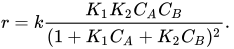
A reaction can also have an undefined reaction order with respect to a reactant if the rate is not simply proportional to some power of the concentration of that reactant; for example, one cannot talk about reaction order in the rate equation for a bimolecular reaction between adsorbed molecules:
- r=kK1K2CACB(1+K1CA+K2CB)2.{displaystyle r=k{frac {K_{1}K_{2}C_{A}C_{B}}{(1+K_{1}C_{A}+K_{2}C_{B})^{2}}}.,}
Contents
1 Definition
2 Power laws
2.1 Determination of reaction order
2.1.1 Method of initial rates
2.1.2 Integral method
2.1.3 Method of flooding
2.2 Zero order
2.3 First order
2.4 Second order
2.5 Pseudo-first order
2.6 Summary for reaction orders 0, 1, 2, and n
2.7 Fractional order
3 Complex laws
3.1 Mixed order
3.2 Negative order
4 Opposed reactions
4.1 Simple example
4.2 Generalization of simple example
5 Consecutive reactions
6 Parallel or competitive reactions
6.1 Two first order reactions
6.2 One first order and one second order reaction
7 Stoichiometric reaction networks
8 General dynamics of unimolecular conversion
9 See also
10 References
11 Further reading
12 External links
Definition
Consider a typical chemical reaction in which two reactants A and B combine to form a product C:
- A+2B→3C.{displaystyle mathrm {A} +2mathrm {B} rightarrow 3mathrm {C} .}

This can also be written
- 0=−A−2B+3C.{displaystyle 0=-mathrm {A} -2mathrm {B} +3mathrm {C} .}

The prefactors -1, -2 and 3 (with negative signs for reactants because they are consumed) are known as stoichiometric coefficients. One molecule of A combines with two of B to form 3 of C, so if we use the symbol [X] for the number of moles of chemical X,[2]
- −d[A]dt=−12d[B]dt=13d[C]dt.{displaystyle -{frac {d[mathrm {A} ]}{dt}}=-{frac {1}{2}}{frac {d[mathrm {B} ]}{dt}}={frac {1}{3}}{frac {d[mathrm {C} ]}{dt}}.}
![{displaystyle -{frac {d[mathrm {A} ]}{dt}}=-{frac {1}{2}}{frac {d[mathrm {B} ]}{dt}}={frac {1}{3}}{frac {d[mathrm {C} ]}{dt}}.}](https://wikimedia.org/api/rest_v1/media/math/render/svg/5f7ab4335384a8b42d4eb22635f09b6ce2fc1e78)
If the reaction takes place in a closed system at constant temperature and volume, without a build-up of reaction intermediates, the reaction rate r is defined as
- r=1νid[Xi]dt,{displaystyle r={frac {1}{nu _{i}}}{frac {d[mathrm {X} _{i}]}{dt}},}
![{displaystyle r={frac {1}{nu _{i}}}{frac {d[mathrm {X} _{i}]}{dt}},}](https://wikimedia.org/api/rest_v1/media/math/render/svg/8ee765fcdb497011c86bd6896db1957aeb75c7b1)
where νi is the stoichiometric coefficient for chemical Xi.[3]
The reaction rate has some functional dependence on the concentrations of the reactants,
- r=f([A],[B],…),{displaystyle r=fleft([mathrm {A} ],[mathrm {B} ],ldots right),}
![{displaystyle r=fleft([mathrm {A} ],[mathrm {B} ],ldots right),}](https://wikimedia.org/api/rest_v1/media/math/render/svg/b5f84ba1064965a051c58037b139f1521d761f26)
and this dependence is known as the rate equation or rate law.[4] This law generally cannot be deduced from the chemical equation and must be determined by experiment.[5]
Power laws
A common form for the rate equation is a power law:[6]
- r=k[A]x[B]y…{displaystyle r=k[A]^{x}[B]^{y}ldots }
![{displaystyle r=k[A]^{x}[B]^{y}ldots }](https://wikimedia.org/api/rest_v1/media/math/render/svg/dd82794310adf4c429e7af5e4fb129033c15e5f3)
The constant k is called the rate constant. The exponents, which can be fractional,[6] are called partial orders of reaction and their sum is the overall order of reaction.[7]
In a dilute solution, an elementary reaction (one having a single step with a single transition state) is empirically found to obey the law of mass action. This predicts that the rate depends only on the concentrations of the reactants, raised to the powers of their stoichiometric coefficients.[8]
Determination of reaction order
Method of initial rates
The natural logarithm of the power-law rate equation is
- lnr=lnk+xln[A]+yln[B]+...{displaystyle ln r=ln k+xln[A]+yln[B]+...}
![ln r=ln k+xln[A]+yln[B]+...](https://wikimedia.org/api/rest_v1/media/math/render/svg/f4c0c0c6cd265c18a4c75f57247fc6291d695f70)
This can be used to estimate the order of reaction of each reactant. For example, the initial rate can be measured in a series of experiments at different initial concentrations of reactant A with all other concentrations [B], [C], ... kept constant, so that
- lnr=xln[A]+constant.{displaystyle ln r=xln[A]+{textrm {constant}}.}
![{displaystyle ln r=xln[A]+{textrm {constant}}.}](https://wikimedia.org/api/rest_v1/media/math/render/svg/d6f61e0f6fe8abb4ec9063291e0fc5fbfa6404a6)
The slope of a graph of lnr{displaystyle ln r}
![ln[A]](https://wikimedia.org/api/rest_v1/media/math/render/svg/e9e61acfbe26ddca702da7fcc61da9372fde4f4d)
However, this method is not always reliable because
- measurement of the initial rate requires accurate determination of small changes in concentration in short times (compared to the reaction half-life) and is sensitive to errors, and
- the rate equation will not be completely determined if the rate also depends on substances not present at the beginning of the reaction, such as intermediates or products.
Integral method
The tentative rate equation determined by the method of initial rates is therefore normally verified by comparing the concentrations measured over a longer time (several half-lives) with the integrated form of the rate equation.
For example, the integrated rate law for a first-order reaction is
ln[A]=−kt+ln[A]0{displaystyle ln {[A]}=-kt+ln {[A]_{0}}},
where [A] is the concentration at time t and [A]0 is the initial concentration at zero time. The first-order rate law is confirmed if ln[A]{displaystyle ln {[A]}}![ln {[A]}](https://wikimedia.org/api/rest_v1/media/math/render/svg/d145d4f5d2bff5b617ad06dceb36a3a6511ffe1f)

Method of flooding
The partial order with respect to a given reactant can be evaluated by the method of flooding (or of isolation) of Ostwald. In this method, the concentration of one reactant is measured with all other reactants in large excess so that their concentration remains essentially constant. For a reaction a·A + b·B → c·C with rate law: r=k⋅[A]x⋅[B]y{displaystyle r=kcdot [{rm {A}}]^{x}cdot [{rm {B}}]^{y}}![{displaystyle r=kcdot [{rm {A}}]^{x}cdot [{rm {B}}]^{y}}](https://wikimedia.org/api/rest_v1/media/math/render/svg/c12c128148b283c01d9a31c69e6cd00d854eedae)
r=k′⋅[A]x{displaystyle r=k'cdot [{rm {A}}]^{x}}![{displaystyle r=k'cdot [{rm {A}}]^{x}}](https://wikimedia.org/api/rest_v1/media/math/render/svg/ba86bd649685917d48d0cd31fa40c5266c0ace4a)
![{displaystyle k'=kcdot [{rm {B}}]^{y}}](https://wikimedia.org/api/rest_v1/media/math/render/svg/458898dfc11f2b8ecf44c3f68319b702b9ff1b8a)
and x may be determined by the integral method. The order y with respect to B under the same conditions (with B in excess) is determined by a series of similar experiments with a range of initial concentration [B]0 so that the variation of k' can be measured.[13]
Zero order
For zero-order reactions, the reaction rate is independent of the concentration of a reactant, so that changing its concentration has no effect on the speed of the reaction. Thus, the concentration changes linearly with time. This may occur when there is a bottleneck which limits the number of reactant molecules that can react at the same time, for example if the reaction requires contact with an enzyme or a catalytic surface.[14]
Many enzyme-catalyzed reactions are zero order, provided that the reactant concentration is much greater than the enzyme concentration which controls the rate, so that the enzyme is saturated. For example, the biological oxidation of ethanol to acetaldehyde by the enzyme liver alcohol dehydrogenase (LADH) is zero order in ethanol.[15]
Similarly reactions with heterogeneous catalysis can be zero order if the catalytic surface is saturated. For example, the decomposition of phosphine (PH3) on a hot tungsten surface at high pressure is zero order in phosphine which decomposes at a constant rate.[14]
In homogeneous catalysis zero order behavior can come about from reversible inhibition. For example, ring-opening metathesis polymerization using third-generation Grubbs catalyst exhibits zero order behavior in catalyst due to the reversible inhibition that is occur between the pyridine and the ruthenium center.[16]
First order
A first order reaction depends on the concentration of only one reactant (a unimolecular reaction). Other reactants can be present, but each will be zero order. The rate law for such a reaction is
- −d[A]dt=k[A],{displaystyle -{frac {d[{ce {A}}]}{dt}}=k[{ce {A}}],}
![{displaystyle -{frac {d[{ce {A}}]}{dt}}=k[{ce {A}}],}](https://wikimedia.org/api/rest_v1/media/math/render/svg/9f7785d62f81535b155883b6662c78c18637db73)
The half-life is independent of the starting concentration and is given by t1/2=ln(2)k{displaystyle t_{1/2}={frac {ln {(2)}}{k}}}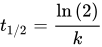
Examples of such reactions are:
- H2O2(l)⟶H2O(l)+12O2(g){displaystyle {ce {H2O2 (l) -> {H2O (l)}+ 1/2O2 (g)}}}
- SO2Cl2(l)⟶SO2(g)+Cl2(g){displaystyle {ce {SO2Cl2 (l) -> {SO2 (g)}+ Cl2 (g)}}}
- 2N2O5(g)⟶4NO2(g)+O2(g){displaystyle {ce {2N2O5 (g) -> {4NO2 (g)}+ O2 (g)}}}


In organic chemistry, the class of SN1 (nucleophilic substitution unimolecular) reactions consists of first-order reactions. For example, in the reaction of aryldiazonium ions with nucleophiles in aqueous solution ArN2+ + X− → ArX + N2, the rate equation is r = k[ArN2+], where Ar indicates an aryl group.[17]
Second order
A reaction is said to be second order when the overall order is two. The rate of a second-order reaction may be proportional to one concentration squared r=k[A]2{displaystyle r=k[A]^{2},}![r=k[A]^{2},](https://wikimedia.org/api/rest_v1/media/math/render/svg/b2e083d4871e27dfbd6b617ea480b07c911ec6b2)
![r=k[A][B],](https://wikimedia.org/api/rest_v1/media/math/render/svg/ff3e6b6a859f72bb5a009f6c5b47ea3f6f2d4c85)
![{displaystyle r=k[{ce {NO2}}]^{2},}](https://wikimedia.org/api/rest_v1/media/math/render/svg/2d9a8baa9862c8aa18e4fb142bd81245ff4b49b0)
For the rate proportional to a single concentration squared, the time dependence of the concentration is given by
- 1[A]=1[A]0+kt{displaystyle {ce {{frac {1}{[A]}}= {frac {1}{[A]0}}+ kt}}}
![{displaystyle {ce {{frac {1}{[A]}}= {frac {1}{[A]0}}+ kt}}}](https://wikimedia.org/api/rest_v1/media/math/render/svg/61d73c70a37944c0eb5e4f5f2f5e584233bb0467)
The time dependence for a rate proportional to two unequal concentrations is
[A][B]=[A]0[B]0e([A]0−[B]0)kt{displaystyle {ce {{frac {[A]}{[B]}}={frac {[A]0}{[B]0}}{mathit {e}}^{([A]0-[B]0){mathit {kt}}}}}};
if the concentrations are equal, they satisfy the previous equation.
The second type includes nucleophillic addition-elimination reactions, such as the alkaline hydrolysis of ethyl acetate:[17]
- CH3COOC2H5 + OH− → CH3COO− + C2H5OH
This reaction is first-order in each reactant and second-order overall: r = k[CH3COOC2H5][OH−]
If the same hydrolysis reaction is catalyzed by imidazole, the rate equation becomes r = k[imidazole][CH3COOC2H5].[17] The rate is first-order in one reactant (ethyl acetate), and also first-order in imidazole which as a catalyst does not appear in the overall chemical equation.
Another well-known class of second-order reactions are the SN2 (bimolecular nucleophilic substitution) reactions, such as the reaction of n-butyl bromide with sodium iodide in acetone:
- CH3CH2CH2CH2Br + NaI → CH3CH2CH2CH2I + NaBr↓
This same compound can be made to undergo a bimolecular (E2) elimination reaction, another common type of second-order reaction, if the sodium iodide and acetone are replaced with sodium tert-butoxide as the salt and tert-butanol as the solvent:
- CH3CH2CH2CH2Br + NaOt-Bu → CH3CH2CH=CH2 + NaBr + HOt-Bu
Pseudo-first order
If the concentration of a reactant remains constant (because it is a catalyst, or because it is in great excess with respect to the other reactants), its concentration can be included in the rate constant, obtaining a pseudo–first-order (or occasionally pseudo–second-order) rate equation. For a typical second-order reaction with rate equation r = k[A][B], if the concentration of reactant B is constant then r = k[A][B] = k'[A], where the pseudo–first-order rate constant
k' = k[B]. The second-order rate equation has been reduced to a pseudo–first-order rate equation, which makes the treatment to obtain an integrated rate equation much easier.
One way to obtain a pseudo-first order reaction is to use a large excess of one reactant (say, [B]≫[A]) so that, as the reaction progresses, only a small fraction of the reactant in excess (B) is consumed, and its concentration can be considered to stay constant. For example, the hydrolysis of esters by dilute mineral acids follows pseudo-first order kinetics where the concentration of water is present in large excess:
- CH3COOCH3 + H2O → CH3COOH + CH3OH
The hydrolysis of sucrose in acid solution is often cited as a first-order reaction with rate r = k[sucrose]. The true rate equation is third-order, r = k[sucrose][H+][H2O]; however, the concentrations of both the catalyst H+ and the solvent H2O are normally constant, so that the reaction is pseudo–first-order.[19]
Summary for reaction orders 0, 1, 2, and n
Elementary reaction steps with order 3 (called ternary reactions) are rare and unlikely to occur. However, overall reactions composed of several elementary steps can, of course, be of any (including non-integer) order.
| Zero order | First order | Second order | nth order | |
|---|---|---|---|---|
| Rate Law | −d[A]/dt=k{displaystyle -{d[{ce {A}}]}/{dt}=k} ![{displaystyle -{d[{ce {A}}]}/{dt}=k}](https://wikimedia.org/api/rest_v1/media/math/render/svg/2d0bbeea17cc80e39fb00450c1ea86631cbe0cfd) | −d[A]/dt=k[A]{displaystyle -{d[{ce {A}}]}/{dt}=k[{ce {A}}]} ![{displaystyle -{d[{ce {A}}]}/{dt}=k[{ce {A}}]}](https://wikimedia.org/api/rest_v1/media/math/render/svg/2f96ec3225358636e6401453fece14afa5283b7e) | −d[A]/dt=k[A]2{displaystyle -{d[{ce {A}}]}/{dt}=k[{ce {A}}]^{2}} ![{displaystyle -{d[{ce {A}}]}/{dt}=k[{ce {A}}]^{2}}](https://wikimedia.org/api/rest_v1/media/math/render/svg/df4c186bb0e3fc1fce4a7d9c8021bc8e49948507) [20] [20] | −d[A]/dt=k[A]n{displaystyle -{d[{ce {A}}]}/{dt}=k[{ce {A}}]^{n}} ![{displaystyle -{d[{ce {A}}]}/{dt}=k[{ce {A}}]^{n}}](https://wikimedia.org/api/rest_v1/media/math/render/svg/21385ff7a769c369af7dcf9f990ae8130eea98cb) |
| Integrated Rate Law | [A]=[A]0−kt{displaystyle {ce {[A] = [A]0}}-kt} ![{displaystyle {ce {[A] = [A]0}}-kt}](https://wikimedia.org/api/rest_v1/media/math/render/svg/6ee628dae90349b5938ea4b7b0638159bb3df8d8) | [A]=[A]0e−kt{displaystyle {ce {[A] = [A]0}}e^{-kt}} ![{displaystyle {ce {[A] = [A]0}}e^{-kt}}](https://wikimedia.org/api/rest_v1/media/math/render/svg/b216310f1c50dec1c5c60b887635a9e2bb87b21e) | 1[A]=1[A]0+kt{displaystyle {frac {1}{{ce {[A]}}}}={frac {1}{{ce {[A]0}}}}+kt} ![{displaystyle {frac {1}{{ce {[A]}}}}={frac {1}{{ce {[A]0}}}}+kt}](https://wikimedia.org/api/rest_v1/media/math/render/svg/577fdc157e8a32cd138f2f7a020a328e6561908e) [20] [20] | 1[A]n−1=1[A]0n−1+(n−1)kt{displaystyle {frac {1}{[{ce {A}}]^{n-1}}}={frac {1}{{ce {[A]0}}^{n-1}}}+(n-1)kt} ![{displaystyle {frac {1}{[{ce {A}}]^{n-1}}}={frac {1}{{ce {[A]0}}^{n-1}}}+(n-1)kt}](https://wikimedia.org/api/rest_v1/media/math/render/svg/b43115aef036e4fe2101d314b6775ea5a4155496) [Except first order] |
| Units of Rate Constant (k) | Ms{displaystyle {rm {frac {M}{s}}}}  | 1s{displaystyle {rm {frac {1}{s}}}}  | 1M⋅s{displaystyle {rm {frac {1}{Mcdot s}}}}  | 1Mn−1⋅s{displaystyle {frac {1}{{rm {M}}^{n-1}cdot {rm {s}}}}}  |
| Linear Plot to determine k | [A] vs. t | ln([A]){displaystyle {ce {ln([A])}}} ![{displaystyle {ce {ln([A])}}}](https://wikimedia.org/api/rest_v1/media/math/render/svg/a8378871d4c6cf8ce28a1a4c9aff69e59ba35fc8) vs. t vs. t | 1[A]{displaystyle {ce {{frac {1}{[A]}}}}} ![{displaystyle {ce {{frac {1}{[A]}}}}}](https://wikimedia.org/api/rest_v1/media/math/render/svg/104bf3c6ecace101c498f948eaf16bf55240619f) vs. t vs. t | 1[A]n−1{displaystyle {ce {frac {1}{[A]^{{mathit {n}}-1}}}}} ![{displaystyle {ce {frac {1}{[A]^{{mathit {n}}-1}}}}}](https://wikimedia.org/api/rest_v1/media/math/render/svg/9cca86ad925386e3c962305fa7ad13100633146e) vs. t vs. t[Except first order] |
| Half-life | t12=[A]02k{displaystyle t_{frac {1}{2}}={frac {{ce {[A]0}}}{2k}}} ![{displaystyle t_{frac {1}{2}}={frac {{ce {[A]0}}}{2k}}}](https://wikimedia.org/api/rest_v1/media/math/render/svg/039f23e90f62bb6d112b1523e7dff9d7969863a0) | t12=ln(2)k{displaystyle t_{frac {1}{2}}={frac {ln(2)}{k}}}  | t12=1k[A]0{displaystyle t_{frac {1}{2}}={frac {1}{k{ce {[A]0}}}}} ![{displaystyle t_{frac {1}{2}}={frac {1}{k{ce {[A]0}}}}}](https://wikimedia.org/api/rest_v1/media/math/render/svg/b25f9b5e7675b3e3f9027241a74ec2d751810c43) [20] [20] | t12=limx→n2x−1−1(x−1)k[A]0x−1{displaystyle t_{frac {1}{2}}=lim _{xto n}{frac {2^{x-1}-1}{(x-1)k{ce {[A]0}}^{x-1}}}} ![{displaystyle t_{frac {1}{2}}=lim _{xto n}{frac {2^{x-1}-1}{(x-1)k{ce {[A]0}}^{x-1}}}}](https://wikimedia.org/api/rest_v1/media/math/render/svg/7e1bdf1a4c894b7545530200130284086dd6836c) [limit only necessary in first order] |
Where M stands for concentration in molarity (mol · L−1), t for time, and k for the reaction rate constant. The half-life of a first order reaction is often expressed as t1/2 = 0.693/k (as ln2 = 0.693).
Fractional order
In fractional order reactions, the order is a non-integer, which often indicates a chemical chain reaction or other complex reaction mechanism. For example, the pyrolysis of acetaldehyde (CH3CHO) into methane and carbon monoxide proceeds with an order of 1.5 with respect to acetaldehyde: r = k[CH3CHO]3/2.[21] The decomposition of phosgene (COCl2) to carbon monoxide and chlorine has order 1 with respect to phosgene itself and order 0.5 with respect to chlorine: r = k[COCl2] [Cl2]1/2.[22]
The order of a chain reaction can be rationalized using the steady state approximation for the concentration of reactive intermediates such as free radicals. For the pyrolysis of acetaldehyde, the Rice-Herzfeld mechanism is
- Initiation
- CH3CHO → •CH3 + •CHO
- Propagation
- •CH3 + CH3CHO → CH3CO• + CH4
- CH3CO• → •CH3 + CO
- Termination
- 2 •CH3 → C2H6
where • denotes a free radical.[21][23] To simplify the theory, the reactions of the •CHO to form a second •CH3 are ignored.
In the steady state, the rates of formation and destruction of methyl radicals are equal, so that
d[⋅CH3]dt=ki[CH3CHO]−kt[⋅CH3]2=0{displaystyle {frac {d[{{ce {.CH3}}}]}{dt}}=k_{i}[{{ce {CH3CHO}}}]-k_{t}[{{ce {.CH3}}}]^{2}=0},
so that the concentration of methyl radical satisfies
[⋅CH3]∝[CH3CHO]12{displaystyle {ce {[.CH3]quad propto quad [CH3CHO]^{1/2}}}}.
The reaction rate equals the rate of the propagation steps which form the main reaction products CH4 and CO:
- v=d[CH4]dt=kp[⋅CH3][CH3CHO]∝[CH3CHO]32{displaystyle v={frac {d[{ce {CH4}}]}{dt}}=k_{p}{ce {[.CH3][CH3CHO]}}quad propto quad {ce {[CH3CHO]^{3/2}}}}
![{displaystyle v={frac {d[{ce {CH4}}]}{dt}}=k_{p}{ce {[.CH3][CH3CHO]}}quad propto quad {ce {[CH3CHO]^{3/2}}}}](https://wikimedia.org/api/rest_v1/media/math/render/svg/a843fd90e81a86f8731fc5744af732f7a9d320b2)
in agreement with the experimental order of 3/2.[21][23]
Complex laws
Mixed order
More complex rate laws have been described as being mixed order if they approximate to the laws for more than one order at different concentrations of the chemical species involved. For example, a rate law of the form r=k1[A]+k2[A]2{displaystyle r=k_{1}[A]+k_{2}[A]^{2}}![r=k_{1}[A]+k_{2}[A]^{2}](https://wikimedia.org/api/rest_v1/media/math/render/svg/d90ff7734705f2886b4c6fe5f76b1915511cc6ed)
Another type of mixed-order rate law has a denominator of two or more terms, often because the identity of the rate-determining step depends on the values of the concentrations. An example is the oxidation of an alcohol to a ketone by hexacyanoferrate (III) ion [Fe(CN)63−] with ruthenate (VI) ion (RuO42−) as catalyst.[25] For this reaction, the rate of disappearance of hexacyanoferrate (III) is r=[Fe(CN)6]2−kα+kβ[Fe(CN)6]2−{displaystyle r={frac {{ce {[Fe(CN)6]^2-}}}{k_{alpha }+k_{beta }{ce {[Fe(CN)6]^2-}}}}}
![{displaystyle r={frac {{ce {[Fe(CN)6]^2-}}}{k_{alpha }+k_{beta }{ce {[Fe(CN)6]^2-}}}}}](https://wikimedia.org/api/rest_v1/media/math/render/svg/93b76311fda85ff9540fdc4d8ed3b092b887339b)
This is zero-order with respect to hexacyanoferrate (III) at the onset of the reaction (when its concentration is high and the ruthenium catalyst is quickly regenerated), but changes to first-order when its concentration decreases and the regeneration of catalyst becomes rate-determining.
Notable mechanisms with mixed-order rate laws with two-term denominators include:
Michaelis-Menten kinetics for enzyme-catalysis: first-order in substrate (second-order overall) at low substrate concentrations, zero order in substrate (first-order overall) at higher substrate concentrations; and- the Lindemann mechanism for unimolecular reactions: second-order at low pressures, first-order at high pressures.
Negative order
A reaction rate can have a negative partial order with respect to a substance. For example, the conversion of ozone (O3) to oxygen follows the rate equation r=k[O3]2[O2]{displaystyle r=k{frac {{ce {[O_3]^2}}}{{ce {[O_2]}}}},}![{displaystyle r=k{frac {{ce {[O_3]^2}}}{{ce {[O_2]}}}},}](https://wikimedia.org/api/rest_v1/media/math/render/svg/696cd51e58b5d105724d713f851bd6c181c93512)
When a partial order is negative, the overall order is usually considered as undefined. In the above example for instance, the reaction is not described as first order even though the sum of the partial orders is 2 + (−1) = 1, because the rate equation is more complex than that of a simple first-order reaction.
Opposed reactions
A pair of forward and reverse reactions may occur simultaneously with comparable speeds. For example, A and B react into X and Y and vice versa (s, t, u, and v are the stoichiometric coefficients):
- sA+tB↽−−⇀uX+vY{displaystyle {ce {{{mathit {s}}A}+{mathit {t}}B<=>{{mathit {u}}X}+{{mathit {v}}Y}}}}

The reaction rate expression for the above reactions (assuming each one is elementary) can be expressed as:
- r=k1[A]s[B]t−k2[X]u[Y]v{displaystyle r={k_{1}[{ce {A}}]^{s}[{ce {B}}]^{t}}-{k_{2}[{ce {X}}]^{u}[{ce {Y}}]^{v}},}
![{displaystyle r={k_{1}[{ce {A}}]^{s}[{ce {B}}]^{t}}-{k_{2}[{ce {X}}]^{u}[{ce {Y}}]^{v}},}](https://wikimedia.org/api/rest_v1/media/math/render/svg/beb42ca1a9aae2680355e836fd86d366fa2b0bfa)
where: k1 is the rate coefficient for the reaction that consumes A and B; k2 is the rate coefficient for the backwards reaction, which consumes X and Y and produces A and B.
The constants k1 and k2 are related to the equilibrium coefficient for the reaction (K) by the following relationship (set r=0 in balance):
- k1[A]s[B]t=k2[X]u[Y]v{displaystyle {k_{1}[{ce {A}}]^{s}[{ce {B}}]^{t}=k_{2}[{ce {X}}]^{u}[{ce {Y}}]^{v}},}
- K=[X]u[Y]v[A]s[B]t=k1k2{displaystyle K={frac {[{ce {X}}]^{u}[{ce {Y}}]^{v}}{[{ce {A}}]^{s}[{ce {B}}]^{t}}}={frac {k_{1}}{k_{2}}}}
![{displaystyle {k_{1}[{ce {A}}]^{s}[{ce {B}}]^{t}=k_{2}[{ce {X}}]^{u}[{ce {Y}}]^{v}},}](https://wikimedia.org/api/rest_v1/media/math/render/svg/0da9adab965ae16cc10af41666cbb8132b183de6)
![{displaystyle K={frac {[{ce {X}}]^{u}[{ce {Y}}]^{v}}{[{ce {A}}]^{s}[{ce {B}}]^{t}}}={frac {k_{1}}{k_{2}}}}](https://wikimedia.org/api/rest_v1/media/math/render/svg/d58978d14243fbb1daf40c64637edc917f803cfb)

Concentration of A (A0 = 0.25 mole/l) and B versus time reaching equilibrium kf = 2 min−1 and kr = 1 min−1
Simple example
In a simple equilibrium between two species:
- A↽−−⇀B{displaystyle {ce {A <=> B}}}

Where the reactions starts with an initial concentration of A, [A]0{displaystyle {ce {[A]0}}}![{displaystyle {ce {[A]0}}}](https://wikimedia.org/api/rest_v1/media/math/render/svg/aa15c54eb19b7614976e3c93ec32ad3a1682698f)
Then the constant K at equilibrium is expressed as:
- K =def kfkb=[B]e[A]e{displaystyle K {stackrel {mathrm {def} }{=}} {frac {k_{f}}{k_{b}}}={frac {left[{ce {B}}right]_{e}}{left[{ce {A}}right]_{e}}}}
![{displaystyle K {stackrel {mathrm {def} }{=}} {frac {k_{f}}{k_{b}}}={frac {left[{ce {B}}right]_{e}}{left[{ce {A}}right]_{e}}}}](https://wikimedia.org/api/rest_v1/media/math/render/svg/5acd07b8aa4cc4c75f64673f61f612ecfc26e642)
Where [A]e{displaystyle [{ce {A}}]_{e}}![{displaystyle [{ce {A}}]_{e}}](https://wikimedia.org/api/rest_v1/media/math/render/svg/7b862e2a4a3fafa60c497c86d0fbb454ad39ee61)
![{displaystyle [{ce {B}}]_{e}}](https://wikimedia.org/api/rest_v1/media/math/render/svg/a244fd960d2daec6774d6035f928ac6944476665)
The concentration of A at time t, [A]t{displaystyle [{ce {A}}]_{t}}![{displaystyle [{ce {A}}]_{t}}](https://wikimedia.org/api/rest_v1/media/math/render/svg/a582a6e92c3ab84b326762cd6d13aed64647846d)
![{displaystyle [{ce {B}}]_{t}}](https://wikimedia.org/api/rest_v1/media/math/render/svg/e7c2379c1071cdb71a97b8c56d886ee083700ffe)
- [A]t=[A]0−[B]t{displaystyle {ce {[A]_{mathit {t}}=[A]0-[B]_{mathit {t}}}}}
![{displaystyle {ce {[A]_{mathit {t}}=[A]0-[B]_{mathit {t}}}}}](https://wikimedia.org/api/rest_v1/media/math/render/svg/34c892392227df5d01f3d5989a6956f0d98f5237)
Note that the term [B]0{displaystyle {ce {[B]0}}}![{displaystyle {ce {[B]0}}}](https://wikimedia.org/api/rest_v1/media/math/render/svg/0e6b489fb443f4abbde6c95a8c7b25f9f0d0e970)
This applies even when time t is at infinity; i.e., equilibrium has been reached:
- [A]e=[A]0−[B]e{displaystyle {ce {[A]_{mathit {e}}=[A]0-[B]_{mathit {e}}}}}
![{displaystyle {ce {[A]_{mathit {e}}=[A]0-[B]_{mathit {e}}}}}](https://wikimedia.org/api/rest_v1/media/math/render/svg/1f49098fe90243ad5d121343281bfc108714db53)
then it follows, by the definition of K, that
- [B]e=x=kfkf+kb[A]0{displaystyle [{ce {B}}]_{e}=x={frac {k_{f}}{k_{f}+k_{b}}}{ce {[A]0}}}
![{displaystyle [{ce {B}}]_{e}=x={frac {k_{f}}{k_{f}+k_{b}}}{ce {[A]0}}}](https://wikimedia.org/api/rest_v1/media/math/render/svg/f3a2452ff1e8b95e97be0084fd137a6946c61990)
and, therefore,
- [A]e=[A]0−x=kbkf+kb[A]0{displaystyle [{ce {A}}]_{e}={ce {[A]0}}-x={frac {k_{b}}{k_{f}+k_{b}}}{ce {[A]0}}}
![{displaystyle [{ce {A}}]_{e}={ce {[A]0}}-x={frac {k_{b}}{k_{f}+k_{b}}}{ce {[A]0}}}](https://wikimedia.org/api/rest_v1/media/math/render/svg/0e53aecd448a92c0e33c9ffe0115fa97df5584c2)
These equations allow us to uncouple the system of differential equations, and allow us to solve for the concentration of A alone.
The reaction equation, given previously as:
- r=k1[A]s[B]t−k2[X]u[Y]v{displaystyle r={k_{1}[{ce {A}}]^{s}[{ce {B}}]^{t}}-{k_{2}[{ce {X}}]^{u}[{ce {Y}}]^{v}},}
- −d[A]dt=kf[A]t−kb[B]t{displaystyle -{frac {d[{ce {A}}]}{dt}}={k_{f}[{ce {A}}]_{t}}-{k_{b}[{ce {B}}]_{t}},}
![{displaystyle -{frac {d[{ce {A}}]}{dt}}={k_{f}[{ce {A}}]_{t}}-{k_{b}[{ce {B}}]_{t}},}](https://wikimedia.org/api/rest_v1/media/math/render/svg/c6516b9d78bd29e006e156203eb7b0db215e532d)
The derivative is negative because this is the rate of the reaction going from A to B, and therefore the concentration of A is decreasing. To simplify annotation, let x be [A]t{displaystyle [{ce {A}}]_{t}}
- −d[A]dt=kf[A]t−kb[B]t−dxdt=kfx−kb[B]t=kfx−kb([A]0−x)=(kf+kb)x−kb[A]0{displaystyle {begin{aligned}-{frac {d[{ce {A}}]}{dt}}&={k_{f}[{ce {A}}]_{t}}-{k_{b}[{ce {B}}]_{t}}\-{frac {dx}{dt}}&={k_{f}x}-{k_{b}[{ce {B}}]_{t}}\&={k_{f}x}-{k_{b}({ce {[A]0}}-x)}\&={(k_{f}+k_{b})x}-{k_{b}{ce {[A]0}}}end{aligned}}}
![{displaystyle {begin{aligned}-{frac {d[{ce {A}}]}{dt}}&={k_{f}[{ce {A}}]_{t}}-{k_{b}[{ce {B}}]_{t}}\-{frac {dx}{dt}}&={k_{f}x}-{k_{b}[{ce {B}}]_{t}}\&={k_{f}x}-{k_{b}({ce {[A]0}}-x)}\&={(k_{f}+k_{b})x}-{k_{b}{ce {[A]0}}}end{aligned}}}](https://wikimedia.org/api/rest_v1/media/math/render/svg/32cc8a79dc3610b3c67e86ecf7b7640a257833e0)
Since:
- kf+kb=kb[A]0xe{displaystyle k_{f}+k_{b}={k_{b}{frac {{ce {[A]0}}}{x_{e}}}}}
![{displaystyle k_{f}+k_{b}={k_{b}{frac {{ce {[A]0}}}{x_{e}}}}}](https://wikimedia.org/api/rest_v1/media/math/render/svg/43c6fe1a0e4898e86528bc48c56fc0c23380b1c7)
The reaction rate becomes:
- dxdt=kb[A]0xe(xe−x){displaystyle {frac {dx}{dt}}={frac {k_{b}{ce {[A]0}}}{x_{e}}}(x_{e}-x)}
![{displaystyle {frac {dx}{dt}}={frac {k_{b}{ce {[A]0}}}{x_{e}}}(x_{e}-x)}](https://wikimedia.org/api/rest_v1/media/math/render/svg/4f81fbbc950a5bdd444074b3e4c775b1d37899d7)
which results in:
- ln([A]0−[A]e[A]t−[A]e)=(kf+kb)t{displaystyle ln left({frac {{ce {[A]0}}-[{ce {A}}]_{e}}{[{ce {A}}]_{t}-[{ce {A}}]_{e}}}right)=(k_{f}+k_{b})t}
![{displaystyle ln left({frac {{ce {[A]0}}-[{ce {A}}]_{e}}{[{ce {A}}]_{t}-[{ce {A}}]_{e}}}right)=(k_{f}+k_{b})t}](https://wikimedia.org/api/rest_v1/media/math/render/svg/03d59f55c019d18dfeda86a7bf943a75dd19a1d6)
A plot of the negative natural logarithm of the concentration of A in time minus the concentration at equilibrium versus time t gives a straight line with slope kf + kb. By measurement of Ae and Be the values of K and the two reaction rate constants will be known.[27]
Generalization of simple example
If the concentration at the time t = 0 is different from above, the simplifications above are invalid, and a system of differential equations must be solved. However, this system can also be solved exactly to yield the following generalized expressions:
- [A]=[A]01kf+kb(kb+kfe−(kf+kb)t)+[B]0kbkf+kb(1−e−(kf+kb)t){displaystyle left[{ce {A}}right]={ce {[A]0}}{frac {1}{k_{f}+k_{b}}}left(k_{b}+k_{f}e^{-left(k_{f}+k_{b}right)t}right)+{ce {[B]0}}{frac {k_{b}}{k_{f}+k_{b}}}left(1-e^{-left(k_{f}+k_{b}right)t}right)}
- [B]=[A]0kfkf+kb(1−e−(kf+kb)t)+[B]01kf+kb(kf+kbe−(kf+kb)t){displaystyle left[{ce {B}}right]={ce {[A]0}}{frac {k_{f}}{k_{f}+k_{b}}}left(1-e^{-left(k_{f}+k_{b}right)t}right)+{ce {[B]0}}{frac {1}{k_{f}+k_{b}}}left(k_{f}+k_{b}e^{-left(k_{f}+k_{b}right)t}right)}
![{displaystyle left[{ce {A}}right]={ce {[A]0}}{frac {1}{k_{f}+k_{b}}}left(k_{b}+k_{f}e^{-left(k_{f}+k_{b}right)t}right)+{ce {[B]0}}{frac {k_{b}}{k_{f}+k_{b}}}left(1-e^{-left(k_{f}+k_{b}right)t}right)}](https://wikimedia.org/api/rest_v1/media/math/render/svg/f94f9ee89ce4aceb3744dc35ad7b3e8f0810a5b8)
![{displaystyle left[{ce {B}}right]={ce {[A]0}}{frac {k_{f}}{k_{f}+k_{b}}}left(1-e^{-left(k_{f}+k_{b}right)t}right)+{ce {[B]0}}{frac {1}{k_{f}+k_{b}}}left(k_{f}+k_{b}e^{-left(k_{f}+k_{b}right)t}right)}](https://wikimedia.org/api/rest_v1/media/math/render/svg/b07b5cca81f055b7516e4008a94535bb9d872587)
When the equilibrium constant is close to unity and the reaction rates very fast for instance in conformational analysis of molecules, other methods are required for the determination of rate constants for instance by complete lineshape analysis in NMR spectroscopy.
Consecutive reactions
If the rate constants for the following reaction are k1{displaystyle k_{1}}


- For reactant A: d[A]dt=−k1[A]{displaystyle {frac {d[{ce {A}}]}{dt}}=-k_{1}[{ce {A}}]}
- For reactant B: d[B]dt=k1[A]−k2[B]{displaystyle {frac {d[{ce {B}}]}{dt}}=k_{1}[{ce {A}}]-k_{2}[{ce {B}}]}
- For product C: d[C]dt=k2[B]{displaystyle {frac {d[{ce {C}}]}{dt}}=k_{2}[{ce {B}}]}
![{displaystyle {frac {d[{ce {A}}]}{dt}}=-k_{1}[{ce {A}}]}](https://wikimedia.org/api/rest_v1/media/math/render/svg/4a8a20f789248c22d7bc6dda260171a9bf1f930e)
![{displaystyle {frac {d[{ce {B}}]}{dt}}=k_{1}[{ce {A}}]-k_{2}[{ce {B}}]}](https://wikimedia.org/api/rest_v1/media/math/render/svg/5839f1ac807d0c6d8d517f8cdcf7a310153eeadb)
![{displaystyle {frac {d[{ce {C}}]}{dt}}=k_{2}[{ce {B}}]}](https://wikimedia.org/api/rest_v1/media/math/render/svg/8d37416fcf3bd237c8e013e8d6318339556b948b)
With the individual concentrations scaled by the total population of reactants to become probabilities, linear systems of differential equations such as these can be formulated as a master equation. The differential equations can be solved analytically and the integrated rate equations are
- [A]=[A]0e−k1t{displaystyle [{ce {A}}]={ce {[A]0}}e^{-k_{1}t}}
![{displaystyle [{ce {A}}]={ce {[A]0}}e^{-k_{1}t}}](https://wikimedia.org/api/rest_v1/media/math/render/svg/a09aceacc1f7d3a5dcc543cd5d24b333c02727a9)
- [B]={[A]0k1k2−k1(e−k1t−e−k2t)+[B]0e−k2tk1≠k2[A]0k1te−k1t+[B]0e−k1totherwise{displaystyle left[{ce {B}}right]={begin{cases}{ce {[A]0}}{frac {k_{1}}{k_{2}-k_{1}}}left(e^{-k_{1}t}-e^{-k_{2}t}right)+{ce {[B]0}}e^{-k_{2}t}&k_{1}neq k_{2}\{ce {[A]0}}k_{1}te^{-k_{1}t}+{ce {[B]0}}e^{-k_{1}t}&{text{otherwise}}\end{cases}}}
![{displaystyle left[{ce {B}}right]={begin{cases}{ce {[A]0}}{frac {k_{1}}{k_{2}-k_{1}}}left(e^{-k_{1}t}-e^{-k_{2}t}right)+{ce {[B]0}}e^{-k_{2}t}&k_{1}neq k_{2}\{ce {[A]0}}k_{1}te^{-k_{1}t}+{ce {[B]0}}e^{-k_{1}t}&{text{otherwise}}\end{cases}}}](https://wikimedia.org/api/rest_v1/media/math/render/svg/c89b95e841018e834ec6846570167585003bce4d)
- [C]={[A]0(1+k1e−k2t−k2e−k1tk2−k1)+[B]0(1−e−k2t)+[C]0k1≠k2[A]0(1−e−k1t−k1te−k1t)+[B]0(1−e−k1t)+[C]0otherwise{displaystyle left[{ce {C}}right]={begin{cases}{ce {[A]0}}left(1+{frac {k_{1}e^{-k_{2}t}-k_{2}e^{-k_{1}t}}{k_{2}-k_{1}}}right)+{ce {[B]0}}left(1-e^{-k_{2}t}right)+{ce {[C]0}}&k_{1}neq k_{2}\{ce {[A]0}}left(1-e^{-k_{1}t}-k_{1}te^{-k_{1}t}right)+{ce {[B]0}}left(1-e^{-k_{1}t}right)+{ce {[C]0}}&{text{otherwise}}\end{cases}}}
![{displaystyle left[{ce {C}}right]={begin{cases}{ce {[A]0}}left(1+{frac {k_{1}e^{-k_{2}t}-k_{2}e^{-k_{1}t}}{k_{2}-k_{1}}}right)+{ce {[B]0}}left(1-e^{-k_{2}t}right)+{ce {[C]0}}&k_{1}neq k_{2}\{ce {[A]0}}left(1-e^{-k_{1}t}-k_{1}te^{-k_{1}t}right)+{ce {[B]0}}left(1-e^{-k_{1}t}right)+{ce {[C]0}}&{text{otherwise}}\end{cases}}}](https://wikimedia.org/api/rest_v1/media/math/render/svg/723b5e07dd50bd74f7e1428c62d37b5d45c70b16)
The steady state approximation leads to very similar results in an easier way.
Parallel or competitive reactions

Time course of two first order, competitive reactions with differing rate constants.
When a substance reacts simultaneously to give two different products, a parallel or competitive reaction is said to take place.
Two first order reactions
A⟶B{displaystyle {ce {A -> B}}}

![{displaystyle -{frac {d[{ce {A}}]}{dt}}=(k_{1}+k_{2})[{ce {A}}]}](https://wikimedia.org/api/rest_v1/media/math/render/svg/36ba353a2dbdb81de9001d88dc304e30b7663985)
![{displaystyle {frac {d[{ce {B}}]}{dt}}=k_{1}[{ce {A}}]}](https://wikimedia.org/api/rest_v1/media/math/render/svg/fe406bb72ef20bf8284c184c9f5036672195b3b5)
![{displaystyle {frac {d[{ce {C}}]}{dt}}=k_{2}[{ce {A}}]}](https://wikimedia.org/api/rest_v1/media/math/render/svg/b299b2242d9caff08c3d2f50d77a7898d9a3ccbb)
The integrated rate equations are then [A]=[A]0e−(k1+k2)t{displaystyle [{ce {A}}]={ce {[A]0}}e^{-(k_{1}+k_{2})t}}![{displaystyle [{ce {A}}]={ce {[A]0}}e^{-(k_{1}+k_{2})t}}](https://wikimedia.org/api/rest_v1/media/math/render/svg/cfc68a99045a6a4895d58eb530b8575c0ca78049)
![{displaystyle [{ce {B}}]={frac {k_{1}}{k_{1}+k_{2}}}{ce {[A]0}}(1-e^{-(k_{1}+k_{2})t})}](https://wikimedia.org/api/rest_v1/media/math/render/svg/7ade5ab53a2191be57ed9a0061d8fd177e7198bf)
[C]=k2k1+k2[A]0(1−e−(k1+k2)t){displaystyle [{ce {C}}]={frac {k_{2}}{k_{1}+k_{2}}}{ce {[A]0}}(1-e^{-(k_{1}+k_{2})t})}![{displaystyle [{ce {C}}]={frac {k_{2}}{k_{1}+k_{2}}}{ce {[A]0}}(1-e^{-(k_{1}+k_{2})t})}](https://wikimedia.org/api/rest_v1/media/math/render/svg/a9c1628e07e81e6ca96058b8d2508592264b5c3c)
One important relationship in this case is [B][C]=k1k2{displaystyle {frac {{ce {[B]}}}{{ce {[C]}}}}={frac {k_{1}}{k_{2}}}}
![{displaystyle {frac {{ce {[B]}}}{{ce {[C]}}}}={frac {k_{1}}{k_{2}}}}](https://wikimedia.org/api/rest_v1/media/math/render/svg/456fc4b45044d3b638848253c55f4bf9da6f6bf2)
One first order and one second order reaction
This can be the case when studying a bimolecular reaction and a simultaneous hydrolysis (which can be treated as pseudo order one) takes place: the hydrolysis complicates the study of the reaction kinetics, because some reactant is being "spent" in a parallel reaction. For example, A reacts with R to give our product C, but meanwhile the hydrolysis reaction takes away an amount of A to give B, a byproduct: A+H2O⟶B{displaystyle {ce {{A}+ H2O -> B}}}

![{displaystyle {frac {d[{ce {B}}]}{dt}}=k_{1}{ce {[A][H2O]}}=k_{1}'[{ce {A}}]}](https://wikimedia.org/api/rest_v1/media/math/render/svg/f10272bc300b4e2f62889a59e3d17d06ee9fe088)
![{displaystyle {frac {d[{ce {C}}]}{dt}}=k_{2}{ce {[A][R]}}}](https://wikimedia.org/api/rest_v1/media/math/render/svg/0c7242ed16a8af29e2ac61a01794d2a0651fd22f)

The integrated rate equation for the main product [C] is [C]=[R]0[1−e−k2k1′[A]0(1−e−k1′t)]{displaystyle {ce {[C]=[R]0}}left[1-e^{-{frac {k_{2}}{k_{1}'}}{ce {[A]0}}(1-e^{-k_{1}'t})}right]}![{displaystyle {ce {[C]=[R]0}}left[1-e^{-{frac {k_{2}}{k_{1}'}}{ce {[A]0}}(1-e^{-k_{1}'t})}right]}](https://wikimedia.org/api/rest_v1/media/math/render/svg/443aa3cb5244e72db532b1b2e29d7baacb5d2e62)
![{displaystyle ln {frac {{ce {[R]0}}}{{ce {[R]0-[C]}}}}={frac {k_{2}{ce {[A]0}}}{k_{1}'}}(1-e^{-k_{1}'t})}](https://wikimedia.org/api/rest_v1/media/math/render/svg/a7420872f140d8d1752413b67968681402de1b18)
![{displaystyle [{ce {B}}]=-{frac {k_{1}'}{k_{2}}}lnleft(1-{frac {ce {[C]}}{[R]0}}right)}](https://wikimedia.org/api/rest_v1/media/math/render/svg/e7eea31c7562d450173538a1d6682eba4177becb)
The integrated equations were analytically obtained but during the process it was assumed that [A]0−[C]≈[A]0{displaystyle {ce {{[A]0}-[C]approx [A]0}}}![{displaystyle {ce {{[A]0}-[C]approx [A]0}}}](https://wikimedia.org/api/rest_v1/media/math/render/svg/a5af58eeaf83a51c6399d698edae8353f1141ff4)
Stoichiometric reaction networks
The most general description of a chemical reaction network considers a number N{displaystyle N}


- s1jX1+s2jX2…+sNjXN→kj r1jX1+ r2jX2+…+rNjXN,{displaystyle s_{1j}{ce {X}}_{1}+s_{2j}{ce {X}}_{2}ldots +s_{Nj}{ce {X}}_{N}{ce {->[k_{j}]}} r_{1j}{ce {X}}_{1}+ r_{2j}{ce {X}}_{2}+ldots +r_{Nj}{ce {X}}_{N},}
![{displaystyle s_{1j}{ce {X}}_{1}+s_{2j}{ce {X}}_{2}ldots +s_{Nj}{ce {X}}_{N}{ce {->[k_{j}]}} r_{1j}{ce {X}}_{1}+ r_{2j}{ce {X}}_{2}+ldots +r_{Nj}{ce {X}}_{N},}](https://wikimedia.org/api/rest_v1/media/math/render/svg/96763034e0ce0946790d669977de8277890c4bde)
which is often written in the equivalent form
- ∑i=1NsijXi→kj∑i=1N rijXi.{displaystyle sum _{i=1}^{N}s_{ij}{ce {X}}_{i}{ce {->[k_{j}]}}sum _{i=1}^{N} r_{ij}{ce {X}}_{i}.}
![{displaystyle sum _{i=1}^{N}s_{ij}{ce {X}}_{i}{ce {->[k_{j}]}}sum _{i=1}^{N} r_{ij}{ce {X}}_{i}.}](https://wikimedia.org/api/rest_v1/media/math/render/svg/1159a8741f1bb485cfc5441f0b791dc9c3a8df4f)
Here
j{displaystyle j}
Xi{displaystyle {ce {X}}_{i}}denotes the i{displaystyle i}
-th chemical species,
kj{displaystyle k_{j}}is the rate constant of the j{displaystyle j}
sij{displaystyle s_{ij}}and rij{displaystyle r_{ij}}
are the stoichiometric coefficients of reactants and products, respectively.
The rate of such reaction can be inferred by the law of mass action
- fj([X→])=kj∏z=1N[Xz]szj{displaystyle f_{j}([{vec {ce {X}}}])=k_{j}prod _{z=1}^{N}[{ce {X}}_{z}]^{s_{zj}}}
![{displaystyle f_{j}([{vec {ce {X}}}])=k_{j}prod _{z=1}^{N}[{ce {X}}_{z}]^{s_{zj}}}](https://wikimedia.org/api/rest_v1/media/math/render/svg/6c30f1163f533f924b5758bc9a25c9cfb62fc63d)
which denotes the flux of molecules per unit time and unit volume. Here [X→]=([X1],[X2],⋅⋅⋅,[XN]){displaystyle {ce {[{vec {X}}]=([X1],[X2],...,[X_{mathit {N}}])}}}![{displaystyle {ce {[{vec {X}}]=([X1],[X2],...,[X_{mathit {N}}])}}}](https://wikimedia.org/api/rest_v1/media/math/render/svg/6054f4082d47007c1260d3332dab7220f82c16a6)
- zero order reactions
for which szj=0{displaystyle s_{zj}=0}

- first order reactions
for which szj=1{displaystyle s_{zj}=1}
- second order reactions
for which szj=1{displaystyle s_{zj}=1}
Each of which are discussed in detail below. One can define the stoichiometric matrix
- Sij=rij−sij,{displaystyle S_{ij}=r_{ij}-s_{ij},}

denoting the net extent of molecules of i{displaystyle i}
- d[Xi]dt=∑j=1RSijfj([X→]).{displaystyle {frac {d[{ce {X}}_{i}]}{dt}}=sum _{j=1}^{R}S_{ij}f_{j}([{vec {ce {X}}}]).}
![{displaystyle {frac {d[{ce {X}}_{i}]}{dt}}=sum _{j=1}^{R}S_{ij}f_{j}([{vec {ce {X}}}]).}](https://wikimedia.org/api/rest_v1/media/math/render/svg/3832148b04c6c43d16a062129878c1b9a31444a2)
Note that this is the product of the stoichiometric matrix and the vector of reaction rate functions.
Particular simple solutions exist in equilibrium, d[Xi]dt=0{displaystyle {frac {d[{ce {X}}_{i}]}{dt}}=0}![{displaystyle {frac {d[{ce {X}}_{i}]}{dt}}=0}](https://wikimedia.org/api/rest_v1/media/math/render/svg/1d296cf4c2577c9058061b5fb6883137cacf3221)


General dynamics of unimolecular conversion
For a general unimolecular reaction involving interconversion of N{displaystyle N}


Also, let X(t)=(X1(t),X2(t),...,XN(t))T{displaystyle X(t)=(X_{1}(t),X_{2}(t),...,X_{N}(t))^{T}}
Let J=(1,1,1,...,1)T{displaystyle J=(1,1,1,...,1)^{T}}
Let I{displaystyle I}
Let Diag{displaystyle Diag}
Let L−1{displaystyle displaystyle {mathcal {L}}^{-1}}

Then the time-evolved state X(t){displaystyle X(t)}
X(t)=L−1[(sI+Diag(KJ)−KT)−1X(0)]{displaystyle X(t)=displaystyle {mathcal {L}}^{-1}[(sI+Diag(KJ)-K^{T})^{-1}X(0)]},
thus providing the relation between the initial conditions of the system and its state at time t{displaystyle t}
See also
- Michaelis–Menten kinetics
- Molecularity
- Petersen matrix
- Reaction-diffusion equation
Reactions on surfaces: rate equations for reactions where at least one of the reactants adsorbs onto a surface- Reaction progress kinetic analysis
- Reaction rate
- Reaction rate constant
- Steady state approximation
References
^ IUPAC Gold Book definition of rate law. See also: According to IUPAC Compendium of Chemical Terminology.
^ Atkins & de Paula 2006, p. 794
^ IUPAC, Compendium of Chemical Terminology, 2nd ed. (the "Gold Book") (1997). Online corrected version: (2006–) "Rate of reaction".
^ Atkins & de Paula 2006, p. 795
^ Atkins & de Paula 2006, p. 796
^ ab Atkins & de Paula 2006, p. 796
^ Connors 1990, p. 13
^ Connors 1990, p. 12
^ Atkins & de Paula 2006, pp. 797–8
^ Espenson 1987, pp. 5–8
^ Atkins & de Paula 2006, pp. 798–800
^ Espenson 1987, pp. 15–18
^ Espenson 1987, pp. 30–31
^ ab Atkins & de Paula 2006, p. 796
^ Tinoco Jr. & Wang 1995, p. 331
^ Walsh, Dylan J.; Lau, Sii Hong; Hyatt, Michael G.; Guironnet, Damien (2017-09-25). "Kinetic Study of Living Ring-Opening Metathesis Polymerization with Third-Generation Grubbs Catalysts". Journal of the American Chemical Society. 139 (39): 13644–13647. doi:10.1021/jacs.7b08010. ISSN 0002-7863. PMID 28944665..mw-parser-output cite.citation{font-style:inherit}.mw-parser-output q{quotes:"""""""'""'"}.mw-parser-output code.cs1-code{color:inherit;background:inherit;border:inherit;padding:inherit}.mw-parser-output .cs1-lock-free a{background:url("//upload.wikimedia.org/wikipedia/commons/thumb/6/65/Lock-green.svg/9px-Lock-green.svg.png")no-repeat;background-position:right .1em center}.mw-parser-output .cs1-lock-limited a,.mw-parser-output .cs1-lock-registration a{background:url("//upload.wikimedia.org/wikipedia/commons/thumb/d/d6/Lock-gray-alt-2.svg/9px-Lock-gray-alt-2.svg.png")no-repeat;background-position:right .1em center}.mw-parser-output .cs1-lock-subscription a{background:url("//upload.wikimedia.org/wikipedia/commons/thumb/a/aa/Lock-red-alt-2.svg/9px-Lock-red-alt-2.svg.png")no-repeat;background-position:right .1em center}.mw-parser-output .cs1-subscription,.mw-parser-output .cs1-registration{color:#555}.mw-parser-output .cs1-subscription span,.mw-parser-output .cs1-registration span{border-bottom:1px dotted;cursor:help}.mw-parser-output .cs1-hidden-error{display:none;font-size:100%}.mw-parser-output .cs1-visible-error{font-size:100%}.mw-parser-output .cs1-subscription,.mw-parser-output .cs1-registration,.mw-parser-output .cs1-format{font-size:95%}.mw-parser-output .cs1-kern-left,.mw-parser-output .cs1-kern-wl-left{padding-left:0.2em}.mw-parser-output .cs1-kern-right,.mw-parser-output .cs1-kern-wl-right{padding-right:0.2em}
^ abc Connors 1990
^ Whitten K. W., Galley K. D. and Davis R. E. General Chemistry (4th edition, Saunders 1992), pp. 638–9
ISBN 0-03-072373-6
^ Tinoco Jr. & Wang 1995, pp. 328–9
^ abc NDRL Radiation Chemistry Data Center. See also: Capellos, Christos; Bielski, Benon H. (1972). Kinetic systems: mathematical description of chemical kinetics in solution. New York: Wiley-Interscience. ISBN 978-0471134503. OCLC 247275.
^ abc Atkins & de Paula 2006, p. 830
^ Laidler 1987, p. 301
^ ab Laidler 1987, pp. 310–311
^ Espenson 1987, pp. 34,60
^ Mucientes, Antonio E.; de la Peña, María A. (November 2006). "Ruthenium(VI)-Catalyzed Oxidation of Alcohols by Hexacyanoferrate(III): An Example of Mixed Order". Journal of Chemical Education. 83 (11): 1643. doi:10.1021/ed083p1643. ISSN 0021-9584.
^ Laidler 1987, p. 305
^ Rushton, Gregory T.; Burns, William G.; Lavin, Judi M.; Chong, Yong S.; Pellechia, Perry; Shimizu, Ken D. (September 2007). "Determination of the Rotational Barrier for Kinetically Stable Conformational Isomers via NMR and 2D TLC". Journal of Chemical Education. 84 (9): 1499. doi:10.1021/ed084p1499. ISSN 0021-9584.
^ Manso, José A.; Pérez-Prior, M. Teresa; García-Santos, M. del Pilar; Calle, Emilio; Casado, Julio (2005). "A Kinetic Approach to the Alkylating Potential of Carcinogenic Lactones". Chemical Research in Toxicology. 18 (7): 1161–1166. CiteSeerX 10.1.1.632.3473. doi:10.1021/tx050031d. PMID 16022509.
^ Heinrich, Reinhart; Schuster, Stefan (2012). The Regulation of Cellular Systems. Springer Science & Business Media. ISBN 9781461311614.
^ Chen, Luonan; Wang, Ruiqi; Li, Chunguang; Aihara, Kazuyuki (2010). Modeling Biomolecular Networks in Cells. doi:10.1007/978-1-84996-214-8. ISBN 978-1-84996-213-1.
^ Szallasi, Z. and Stelling, J. and Periwal, V. (2006) System modeling in cell biology: from concepts to nuts and bolts. MIT Press Cambridge.
^ Iglesias, Pablo A.; Ingalls, Brian P. (2010). Control theory and systems biology. MIT Press. ISBN 9780262013345.
Further reading
.mw-parser-output .refbegin{font-size:90%;margin-bottom:0.5em}.mw-parser-output .refbegin-hanging-indents>ul{list-style-type:none;margin-left:0}.mw-parser-output .refbegin-hanging-indents>ul>li,.mw-parser-output .refbegin-hanging-indents>dl>dd{margin-left:0;padding-left:3.2em;text-indent:-3.2em;list-style:none}.mw-parser-output .refbegin-100{font-size:100%}
Atkins, Peter; de Paula, Julio (2006). "The rates of chemical reactions". Atkins' Physical chemistry (8th ed.). W.H. Freeman. pp. 791–823. ISBN 0-7167-8759-8.
Connors, Kenneth Antonio (1990). Chemical kinetics : the study of reaction rates in solution. John Wiley & Sons. ISBN 9781560810063.
Espenson, James H. (1987). Chemical kinetics and reaction mechanisms (2nd ed.). McGraw Hill. ISBN 9780071139496.
Laidler, Keith James (1987). Chemical kinetics (3rd ed.). Harper & Row. ISBN 9780060438623.
Tinoco Jr., Ignacio; Wang, James C. (1995). Physical chemistry : principles and applications in biological sciences (3rd ed.). Prentice Hall. ISBN 9780131865457.
External links
Chemical kinetics, reaction rate, and order (needs flash player)
Reaction kinetics, examples of important rate laws (lecture with audio).- Rates of Reaction


