Phytolaccaceae
| Phytolaccaceae | |
|---|---|
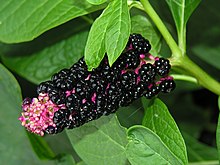 | |
Phytolacca esculenta | |
Scientific classification  | |
| Kingdom: | Plantae |
Clade: | Angiosperms |
Clade: | Eudicots |
| Order: | Caryophyllales |
| Family: | Phytolaccaceae R.Br.[1][2] |
| Genera | |
| |
Synonyms | |
Agdestidaceae Nakai | |
Phytolaccaceae is a family of flowering plants. Such a family has been almost universally recognized by taxonomists, although its circumscription has varied. It is also known as the Pokeweed family.
The APG II system, of 2003 (unchanged from the APG system, of 1998), also recognizes this family and assigns it to the order Caryophyllales in the clade core eudicots. The family comprises five genera, totalling 33 known species.[3] It is divided into the subfamilies Agdestioideae and Phytolaccoideae, with the former Rivinioideae in the Takhtajan system.[4] now placed in its own family Petiveriaceae
Contents
1 Genera and species
2 Genera formerly placed here
3 References
4 External links
Genera and species
The Phytolaccaceae includes the following genera:
Agdestis Moc. & Sessé ex DC. — 1 species
Anisomeria D.Don — 3 species
Ercilla A.Juss. — 2 species
Nowickea J.Martínez & J.A.McDonald — 2 species
Phytolacca L. — ca 25 species
Genera formerly placed here
The following genera were previously included in the Phytolaccaceae:[5]
Achatocarpus Triana → Achatocarpaceae
Barbeuia Thouars → Barbeuiaceae
Gallesia Casar. → Petiveriaceae
Gisekia L. → Gisekiaceae
Hilleria Vell. → Petiveriaceae
Gyrostemon Desf. → Gyrostemonaceae
Ledenbergia Klotzsch ex Moq. → Petiveriaceae
Lophiocarpus Turcz. → Lophiocarpaceae
Microtea Sw. → Microteaceae
Monococcus F.Muell. → Petiveriaceae
Petiveria L. → Petiveriaceae
Phaulothamnus A.Gray → Achatocarpaceae
Rivina L. → Petiveriaceae
Schindleria H.Walter → Petiveriaceae
Seguieria Loefl. → Petiveriaceae
Stegnosperma Benth. → Stegnospermataceae
Trichostigma A.Rich. → Petiveriaceae
References
^ "Family: Phytolaccaceae R. Br., nom. cons". Germplasm Resources Information Network. United States Department of Agriculture. 2003-01-17. Retrieved 2011-10-02..mw-parser-output cite.citation{font-style:inherit}.mw-parser-output .citation q{quotes:"""""""'""'"}.mw-parser-output .citation .cs1-lock-free a{background:url("//upload.wikimedia.org/wikipedia/commons/thumb/6/65/Lock-green.svg/9px-Lock-green.svg.png")no-repeat;background-position:right .1em center}.mw-parser-output .citation .cs1-lock-limited a,.mw-parser-output .citation .cs1-lock-registration a{background:url("//upload.wikimedia.org/wikipedia/commons/thumb/d/d6/Lock-gray-alt-2.svg/9px-Lock-gray-alt-2.svg.png")no-repeat;background-position:right .1em center}.mw-parser-output .citation .cs1-lock-subscription a{background:url("//upload.wikimedia.org/wikipedia/commons/thumb/a/aa/Lock-red-alt-2.svg/9px-Lock-red-alt-2.svg.png")no-repeat;background-position:right .1em center}.mw-parser-output .cs1-subscription,.mw-parser-output .cs1-registration{color:#555}.mw-parser-output .cs1-subscription span,.mw-parser-output .cs1-registration span{border-bottom:1px dotted;cursor:help}.mw-parser-output .cs1-ws-icon a{background:url("//upload.wikimedia.org/wikipedia/commons/thumb/4/4c/Wikisource-logo.svg/12px-Wikisource-logo.svg.png")no-repeat;background-position:right .1em center}.mw-parser-output code.cs1-code{color:inherit;background:inherit;border:inherit;padding:inherit}.mw-parser-output .cs1-hidden-error{display:none;font-size:100%}.mw-parser-output .cs1-visible-error{font-size:100%}.mw-parser-output .cs1-maint{display:none;color:#33aa33;margin-left:0.3em}.mw-parser-output .cs1-subscription,.mw-parser-output .cs1-registration,.mw-parser-output .cs1-format{font-size:95%}.mw-parser-output .cs1-kern-left,.mw-parser-output .cs1-kern-wl-left{padding-left:0.2em}.mw-parser-output .cs1-kern-right,.mw-parser-output .cs1-kern-wl-right{padding-right:0.2em}
^ Angiosperm Phylogeny Group (2009). "An update of the Angiosperm Phylogeny Group classification for the orders and families of flowering plants: APG III" (PDF). Botanical Journal of the Linnean Society. 161 (2): 105–121. doi:10.1111/j.1095-8339.2009.00996.x. Retrieved 2013-07-06.
^ Christenhusz, M. J. M.; Byng, J. W. (2016). "The number of known plants species in the world and its annual increase". Phytotaxa. 261 (3): 201–217. doi:10.11646/phytotaxa.261.3.1.
^ Takhtajan, Armen (2009). Flowering Plants (2 ed.). Springer. p. 136. ISBN 978-1-4020-9608-2.
^ "GRIN genera sometimes placed in Phytolaccaceae". Germplasm Resources Information Network. United States Department of Agriculture. Archived from the original on 18 November 2004. Retrieved 13 October 2015.
External links
 | Wikimedia Commons has media related to Phytolaccaceae. |
 | Wikispecies has information related to Phytolaccaceae |
Phytolaccaceae in L. Watson and M.J. Dallwitz (1992 onwards). The families of flowering plants: descriptions, illustrations, identification, information retrieval. Version: 30 May 2006. http://delta-intkey.com
- Phytolaccaeae in the Flora of North America
- Phytolaccaeae in the Flora of China
- NCBI Taxonomy Browser
- Pictures of representative species
 | This Caryophyllales article is a stub. You can help Wikipedia by expanding it. |


