Inverse magnetostrictive effect
The inverse magnetostrictive effect (also known as magnetoelastic effect or Villarian effect) is the name given to the change of the magnetic susceptibility of a material when subjected to a mechanical stress.
Contents
1 Explanation
1.1 Qualitative explanation of magnetoelastic effect
1.2 Quantitative explanation of magnetoelastic effect
1.3 Magnetoelastic effect in the single crystal
2 Method of testing the magnetoelastic properties of soft magnetic materials
3 Applications of magnetoelastic effect
4 References
5 See also
Explanation
The magnetostriction λ{displaystyle lambda }


Qualitative explanation of magnetoelastic effect
Under a given uni-axial mechanical stress σ{displaystyle sigma }

According to Le Chatelier's principle:
(dλdH)σ=(dBdσ)H{displaystyle left({frac {dlambda }{dH}}right)_{sigma }=left({frac {dB}{dsigma }}right)_{H}}
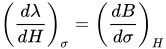
This means, that when the product σλs{displaystyle sigma lambda _{s}}
Quantitative explanation of magnetoelastic effect
In the case of a single stress σ{displaystyle sigma }
Eσ=32λsσsin2(θ){displaystyle E_{sigma }={frac {3}{2}}lambda _{s}sigma sin ^{2}(theta )}
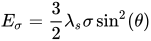
where λs{displaystyle lambda _{s}}
When λs{displaystyle lambda _{s}}
Magnetoelastic effect in the single crystal
In fact, magnetostriction is more complex and depends on the direction of the crystal axes. In iron, the [100] axes are the directions of easy magnetization, while there is little magnetization along the [111] directions (unless the magnetization becomes close to the saturation magnetization, leading to the change of the domain orientation from [111] to [100]). This magnetic anisotropy pushed authors to define two independent longitudinal magnetostrictions λ100{displaystyle lambda _{100}}

- In cubic materials, the magnetostriction along any axis can be defined by a known linear combination of these two constants. For instance, the elongation along [110] is a linear combination of λ100{displaystyle lambda _{100}}
- Under assumptions of isotropic magnetostriction (i.e. domain magnetization is the same in any crystallographic directions), then λ100=λ111=λ{displaystyle lambda _{100}=lambda _{111}=lambda }
and the linear dependence between the elastic energy and the stress is conserved, Eσ=32λσ(α1γ1+α2γ2+α3γ3)2{displaystyle E_{sigma }={frac {3}{2}}lambda sigma (alpha _{1}gamma _{1}+alpha _{2}gamma _{2}+alpha _{3}gamma _{3})^{2}}
. Here, α1{displaystyle alpha _{1}}
, α2{displaystyle alpha _{2}}
and α3{displaystyle alpha _{3}}
are the direction cosines of the domain magnetization, and γ1{displaystyle gamma _{1}}
, γ2{displaystyle gamma _{2}}
,γ3{displaystyle gamma _{3}}
those of the bond directions, towards the crystallographic directions.
Method of testing the magnetoelastic properties of soft magnetic materials
Method suitable for effective testing of magnetoelastic effect in magnetic materials should fulfill the following requirements:[3]
- magnetic circuit of the tested sample should be closed. Open magnetic circuit causes demagnetization, which reduces magnetoelastic effect and complicates its analysis.
- distribution of stresses should be uniform. Value and direction of stresses should be known.
- there should be the possibility of making the magnetizing and sensing windings on the sample - necessary to measure magnetic hysteresis loop under mechanical stresses.
Following testing methods were developed:
- tensile stresses applied to the strip of magnetic material in the shape of a ribbon.[4] Disadvantage: open magnetic circuit of the tested sample.
- tensile or compressive stresses applied to the frame-shaped sample.[5] Disadvantage: only bulk materials may be tested. No stresses in the joints of sample columns.
- compressive stresses applied to the ring core in the sideways direction.[6] Disadvantage: non-uniform stresses distribution in the core .
- tensile or compressive stresses applied axially to the ring sample.[7] Disadvantage: stresses are perpendicular to the magnetizing field.
Applications of magnetoelastic effect
Magnetoelastic effect can be used in development of force sensors.[8][9] This effect was used for sensors:
- in civil engineering.[4]
- for monitoring of large diesel engines in locomotives.[10]
- for monitoring of ball valves.[10]
- for biomedical monitoring.[11]
Magnetoelastic effect have to be also considered as a side effect of accidental application of mechanical stresses to the magnetic core of inductive component, e.g. fluxgates.[12]
References
^ ab Bozorth, R. (1951). Ferromagnetism. Van Nostrand..mw-parser-output cite.citation{font-style:inherit}.mw-parser-output .citation q{quotes:"""""""'""'"}.mw-parser-output .citation .cs1-lock-free a{background:url("//upload.wikimedia.org/wikipedia/commons/thumb/6/65/Lock-green.svg/9px-Lock-green.svg.png")no-repeat;background-position:right .1em center}.mw-parser-output .citation .cs1-lock-limited a,.mw-parser-output .citation .cs1-lock-registration a{background:url("//upload.wikimedia.org/wikipedia/commons/thumb/d/d6/Lock-gray-alt-2.svg/9px-Lock-gray-alt-2.svg.png")no-repeat;background-position:right .1em center}.mw-parser-output .citation .cs1-lock-subscription a{background:url("//upload.wikimedia.org/wikipedia/commons/thumb/a/aa/Lock-red-alt-2.svg/9px-Lock-red-alt-2.svg.png")no-repeat;background-position:right .1em center}.mw-parser-output .cs1-subscription,.mw-parser-output .cs1-registration{color:#555}.mw-parser-output .cs1-subscription span,.mw-parser-output .cs1-registration span{border-bottom:1px dotted;cursor:help}.mw-parser-output .cs1-ws-icon a{background:url("//upload.wikimedia.org/wikipedia/commons/thumb/4/4c/Wikisource-logo.svg/12px-Wikisource-logo.svg.png")no-repeat;background-position:right .1em center}.mw-parser-output code.cs1-code{color:inherit;background:inherit;border:inherit;padding:inherit}.mw-parser-output .cs1-hidden-error{display:none;font-size:100%}.mw-parser-output .cs1-visible-error{font-size:100%}.mw-parser-output .cs1-maint{display:none;color:#33aa33;margin-left:0.3em}.mw-parser-output .cs1-subscription,.mw-parser-output .cs1-registration,.mw-parser-output .cs1-format{font-size:95%}.mw-parser-output .cs1-kern-left,.mw-parser-output .cs1-kern-wl-left{padding-left:0.2em}.mw-parser-output .cs1-kern-right,.mw-parser-output .cs1-kern-wl-right{padding-right:0.2em}
^ Salach, J.; Szewczyk, R.; Bienkowski, A.; Frydrych, P. (2010). "Methodology of testing the magnetoelastic characteristics of ring-shaped cores under uniform compressive and tensile stresses" (PDF). Journal of Electrical Engineering. 61 (7): 93.
^ Bienkowski, A.; Kolano, R.; Szewczyk, R (2003). "New method of characterization of magnetoelastic properties of amorphous ring cores". Journal of Magnetism and Magnetic Materials. 254: 67. Bibcode:2003JMMM..254...67B. doi:10.1016/S0304-8853(02)00755-2.
^ ab Bydzovsky, J.; Kollar, M.; Svec, P.; et al. (2001). "Magnetoelastic properties of CoFeCrSiB amorphous ribbons - a possibility of their application" (PDF). Journal of Electrical Engineering. 52: 205.
^ Bienkowski, A.; Rozniatowski, K.; Szewczyk, R (2003). "Effects of stress and its dependence on microstructure in Mn-Zn ferrite for power applications". Journal of Magnetism and Magnetic Materials. 254: 547. Bibcode:2003JMMM..254..547B. doi:10.1016/S0304-8853(02)00861-2.
^ Mohri, K.; Korekoda, S. (1978). "New force transducers using amorphous ribbon cores". IEEE Transactions on Magnetics. 14: 1071. Bibcode:1978ITM....14.1071M. doi:10.1109/TMAG.1978.1059990.
^ Szewczyk, R.; Bienkowski, A.; Salach, J.; et al. (2003). "The influence of microstructure on compressive stress characteristics of the FINEMET-type nanocrystalline sensors" (PDF). Journal of Optoelectronics and Advanced Materials. 5: 705.
^ Bienkowski, A.; Szewczyk, R. (2004). "The possibility of utilizing the high permeability magnetic materials in construction of magnetoelastic stress and force sensors". Sensors and Actuators A - Physical. Elsevier. 113: 270. doi:10.1016/j.sna.2004.01.010.
^ Bienkowski, A.; Szewczyk, R. (2004). "New possibility of utilizing amorphous ring cores as stress sensor". Physica Status Solidi A. 189: 787. Bibcode:2002PSSAR.189..787B. doi:10.1002/1521-396X(200202)189:3<787::AID-PSSA787>3.0.CO;2-G.
^ ab Bienkowski, A.; Szewczyk, R.; Salach, J. (2010). "Industrial Application of Magnetoelastic Force and Torque Sensors" (PDF). Acta Physica Polonica A. 118: 1008.
^ Meydan, T.; Oduncu, H. (1997). "Enhancement of magnetostrictive properties of amorphous ribbons for a biomedical application". Sensors and Actuators A - Physical. Elsevier. 59: 192. doi:10.1016/S0924-4247(97)80172-0.
^ Szewczyk, R.; Bienkowski, A. (2004). "Stress dependence of sensitivity of fluxgate sensor". Sensors and Actuators A - Physical. Elsevier. 110 (1–3): 232. doi:10.1016/j.sna.2003.10.029.
See also
- Magnetostriction
- Magnetocrystalline anisotropy


