2-Chloroethanol
 | |||
| |||
| Names | |||
|---|---|---|---|
Preferred IUPAC name 2-Chloroethan-1-ol[1] | |||
Other names
| |||
| Identifiers | |||
CAS Number |
| ||
3D model (JSmol) |
| ||
| 3DMet | B01042 | ||
Beilstein Reference | 878139 | ||
ChEBI |
| ||
ChEMBL |
| ||
ChemSpider |
| ||
ECHA InfoCard | 100.003.146 | ||
EC Number | 203-459-7 | ||
Gmelin Reference | 25389 | ||
KEGG |
| ||
MeSH | Ethylene+Chlorohydrin | ||
PubChem CID |
| ||
RTECS number | KK0875000 | ||
UNII |
| ||
UN number | 1135 | ||
InChI
| |||
SMILES
| |||
| Properties | |||
Chemical formula | C2H5ClO | ||
Molar mass | 80.51 g·mol−1 | ||
| Appearance | Colourless liquid | ||
Odor | Faint, ether-like | ||
Density | 1.201 g·mL−1 | ||
Melting point | −62.60 °C; −80.68 °F; 210.55 K | ||
Boiling point | 127–131 °C; 260–268 °F; 400–404 K | ||
Solubility in water | Miscible[3] | ||
log P | −0.107 | ||
Vapor pressure | 700 Pa (at 20 °C) | ||
Refractive index (nD) | 1.441 | ||
| Thermochemistry | |||
Std enthalpy of combustion (ΔcH | −1.1914 MJ·mol−1 | ||
| Hazards | |||
GHS pictograms |   | ||
GHS signal word | DANGER | ||
GHS hazard statements | H226, H300, H310, H330 | ||
GHS precautionary statements | P260, P280, P284, P301+310, P302+350 | ||
NFPA 704 |  2 4 0 | ||
Flash point | 55 °C (131 °F; 328 K) | ||
Autoignition temperature | 425 °C (797 °F; 698 K) | ||
Explosive limits | 5–16% | ||
| Lethal dose or concentration (LD, LC): | |||
LD50 (median dose) |
| ||
LC50 (median concentration) |
| ||
| US health exposure limits (NIOSH): | |||
PEL (Permissible) | TWA 5 ppm (16 mg/m3) [skin][3] | ||
REL (Recommended) | C 1 ppm (3 mg/m3) [skin][3] | ||
IDLH (Immediate danger) | 7 ppm[3] | ||
| Related compounds | |||
Related compounds |
| ||
Except where otherwise noted, data are given for materials in their standard state (at 25 °C [77 °F], 100 kPa). | |||
 N verify (what is N verify (what is  Y Y N ?) N ?) | |||
Infobox references | |||

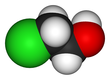
2-Chloroethanol is a chemical compound with the formula HOCH2CH2Cl and the simplest chlorohydrin. This colorless liquid has a pleasant ether-like odor. It is miscible with water. The molecule is bifunctional, consisting of both an alkyl chloride and an alcohol functional groups.
Contents
1 Synthesis and applications
2 Environmental aspects
3 Safety
4 References
Synthesis and applications
2-Chloroethanol is produced by treating ethylene with hypochlorous acid:

2-Chloroethanol was once produced on a large scale as a precursor to ethylene oxide:

This application has been supplanted by the greener direct oxidation of ethylene. Otherwise chloroethanol is used in a number of specialized applications.[6] Several dyes are prepared by the alkylation of aniline derivatives with chloroethanol.[7] It is a building block in the production of pharmaceuticals, biocides and plasticizers. It is also used for manufacture of thiodiglycol. It is a solvent for cellulose acetate and ethyl cellulose, textile printing dyes, in dewaxing, refining of rosin, extraction of pine lignin, and the cleaning of machines.
Environmental aspects
Chloroethanol is a metabolite in the degradation of 1,2-dichloroethane. The alcohol is then further oxidized via chloroacetaldehyde to chloroacetate. This metabolic pathway is topical since billions of kilograms of 1,2-dichloroethane are processed annually as a precursor to vinyl chloride.[8]
Safety
2-Chloroethanol is toxic with an LD50 of 89 mg/kg in rats. Like most organochlorine compounds, chloroethanol combusts to yield hydrogen chloride and phosgene.
In regards to dermal exposure to 2-chloroethanol, the Occupational Safety and Health Administration has set a permissible exposure limit of 5 ppm (16 mg/m3) over an eight-hour time-weighted average, while the National Institute for Occupational Safety and Health has a more protective recommended exposure limit of a 1 ppm (3 mg/m3) exposure ceiling.[9]
It is classified as an extremely hazardous substance in the United States as defined in Section 302 of the U.S. Emergency Planning and Community Right-to-Know Act (42 U.S.C. 11002), and is subject to strict reporting requirements by facilities which produce, store, or use it in significant quantities.[10]
References
^ ab
Nomenclature of Organic Chemistry : IUPAC Recommendations and Preferred Names 2013 (Blue Book). Cambridge: The Royal Society of Chemistry. 2014. p. 29. doi:10.1039/9781849733069-FP001. ISBN 978-0-85404-182-4.For example, the omission of the locant ‘1’ in 2-chloroethanol, while permissible in general usage, is not allowed in preferred IUPAC names, thus the name 2-chloroethan-1-ol is the PIN.
.mw-parser-output cite.citation{font-style:inherit}.mw-parser-output q{quotes:"""""""'""'"}.mw-parser-output code.cs1-code{color:inherit;background:inherit;border:inherit;padding:inherit}.mw-parser-output .cs1-lock-free a{background:url("//upload.wikimedia.org/wikipedia/commons/thumb/6/65/Lock-green.svg/9px-Lock-green.svg.png")no-repeat;background-position:right .1em center}.mw-parser-output .cs1-lock-limited a,.mw-parser-output .cs1-lock-registration a{background:url("//upload.wikimedia.org/wikipedia/commons/thumb/d/d6/Lock-gray-alt-2.svg/9px-Lock-gray-alt-2.svg.png")no-repeat;background-position:right .1em center}.mw-parser-output .cs1-lock-subscription a{background:url("//upload.wikimedia.org/wikipedia/commons/thumb/a/aa/Lock-red-alt-2.svg/9px-Lock-red-alt-2.svg.png")no-repeat;background-position:right .1em center}.mw-parser-output .cs1-subscription,.mw-parser-output .cs1-registration{color:#555}.mw-parser-output .cs1-subscription span,.mw-parser-output .cs1-registration span{border-bottom:1px dotted;cursor:help}.mw-parser-output .cs1-hidden-error{display:none;font-size:100%}.mw-parser-output .cs1-visible-error{font-size:100%}.mw-parser-output .cs1-subscription,.mw-parser-output .cs1-registration,.mw-parser-output .cs1-format{font-size:95%}.mw-parser-output .cs1-kern-left,.mw-parser-output .cs1-kern-wl-left{padding-left:0.2em}.mw-parser-output .cs1-kern-right,.mw-parser-output .cs1-kern-wl-right{padding-right:0.2em}
^ abcdefghijkl Depositor-supplied synonyms for CID 34
^ abcd "NIOSH Pocket Guide to Chemical Hazards #0268". National Institute for Occupational Safety and Health (NIOSH).
^ ab "Ethylene chlorohydrin". Immediately Dangerous to Life and Health Concentrations (IDLH). National Institute for Occupational Safety and Health (NIOSH).
^ http://www.newenv.com/resources/nfpa_chemicals
^ Gordon Y. T. Liu, W. Frank Richey, Joanne E. Betso "Chlorohydrins" in Ullmann's Encyclopedia of Industrial Chemistry, 2002, Wiley-VCH, Weinheim. doi:10.1002/14356007.a06_565
^ Roderich Raue and John F. Corbett "Nitro and Nitroso Dyes" in Ullmann's Encyclopedia of Industrial Chemistry, 2002, Wiley-VCH, Weinheim. doi:10.1002/14356007.a17_383
^ 1. Janssen, D. B.; van der Ploeg, J. R. and Pries, F., "Genetics and Biochemistry of 1,2-Dichloroethane Degradation", Biodegradation, 1994, volume 5, pp. 249-57.doi:10.1007/BF00696463
^ CDC - NIOSH Pocket Guide to Chemical Hazards
^ "40 C.F.R.: Appendix A to Part 355—The List of Extremely Hazardous Substances and Their Threshold Planning Quantities" (PDF) (July 1, 2008 ed.). Government Printing Office. Retrieved October 29, 2011.
Authority control  |
|
|---|


