Michele Alboreto
| Michele Alboreto | |||||||||||||||||||||||||||||
|---|---|---|---|---|---|---|---|---|---|---|---|---|---|---|---|---|---|---|---|---|---|---|---|---|---|---|---|---|---|
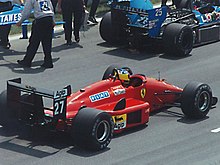 Alboreto in 1988, driving for Scuderia Ferrari. | |||||||||||||||||||||||||||||
| Nationality |  Italian Italian | ||||||||||||||||||||||||||||
| Born | (1956-12-23)23 December 1956 Milan, Italy | ||||||||||||||||||||||||||||
| Died | 25 April 2001(2001-04-25) (aged 44) EuroSpeedway Lausitz, Germany | ||||||||||||||||||||||||||||
| |||||||||||||||||||||||||||||
| |||||||||||||||||||||||||||||
Michele Alboreto (23 December 1956 – 25 April 2001) was an Italian racing driver. He was runner up to Alain Prost in the 1985 Formula One World Championship, as well as winning the 1997 24 Hours of Le Mans and 2001 12 Hours of Sebring sports car races. Alboreto competed in Formula One from 1981 until 1994, racing for a number of teams, including five seasons (1984–88) for Ferrari.
The Italian's career in motorsport began in 1976, racing a car he and a number of his friends had built in the Formula Monza series. The car, however, achieved very little success and two years later Alboreto moved up to Formula Three. Wins in the Italian Formula Three championship and a European Formula Three Championship crown in 1980 paved the way for the Italian's entrance into Formula One with the Tyrrell team.
Two wins, the first in the final round of the 1982 season in Las Vegas, and the second a year later in Detroit, earned him a place with the Ferrari team. Alboreto took three wins for the Italian team and challenged Alain Prost for the 1985 Championship, eventually losing out by 20 points. The following three seasons were less successful, however, and at the end of the 1988 campaign, the Italian left Ferrari and re-signed with his former employers Tyrrell, where he stayed until joining Larrousse midway through 1989.
Further seasons with Footwork, Scuderia Italia and Minardi followed during the tail end of his F1 career. In 1995, Alboreto moved on to sportscars and a year later the American IndyCar series. He took his final major victories, the 1997 Le Mans 24 Hours and 2001 Sebring 12 Hours, with German manufacturers Porsche and Audi respectively. In 2001, a month after his Sebring victory, he was killed testing an Audi R8 at the Lausitzring in Germany.
Contents
1 Career
1.1 1976–1981: Junior formulae
1.2 1980–1983: Sportscars
1.3 Formula One
1.3.1 1981–1983: Tyrrell
1.3.2 1984–1988: Ferrari
1.3.3 1989: Tyrrell and Larrousse
1.3.4 1990–1992: Footwork
1.3.5 1993–1994: Scuderia Italia and Minardi
1.4 1994–2001: Post-Formula One career
2 Death
3 Helmet
4 Racing career results
4.1 Career summary
4.2 Complete World Sportscar Championship results
4.3 Complete 24 Hours of Le Mans results
4.4 Complete European Formula Two Championship results
4.5 Complete Formula One World Championship results
4.6 Complete Deutsche Tourenwagen Meisterschaft results
4.7 Complete International Touring Car Championship results
4.8 American Open-Wheel racing results
4.8.1 Indy Racing League
4.8.2 Indianapolis 500
4.9 Complete American Le Mans Series results
5 References
5.1 Websites
5.2 Notes
6 External links
Career
1976–1981: Junior formulae
Michele Alboreto started his career in 1976 racing in Formula Monza with a car he and his friends built, known as the "CMR".[1] The car itself proved to be uncompetitive and in 1978 Alboreto, now in a more competitive March, moved over to Formula Italia where he began to take race wins. Two years later Alboreto moved up to Formula Three, racing in a Euroracing-entered March-Toyota in both the European and Italian series.[1] In his début Formula Three season, Alboreto finished 6th and 2nd respectively in the two championships, scoring three wins in the Italian series.
1980 would prove to be the Italian's final, and most successful, year in Formula Three where he took the European crown and finished third in the Italian championship, taking five wins between the two series. An appearance in the British Championship was also made that year.
Alboreto's European title earned him a move into Formula Two, a feeder series for Formula One, with the Minardi team. He scored Minardi's only F2 victory, at Misano, during the 1981 season where he finished eighth in the championship.[1]
1980–1983: Sportscars
Despite his career in open wheel racing, Alboreto was chosen by Lancia to be part of their official squad in the World Championship for Makes, running in rounds which did not conflict with his other races. He shared the Group 5 category Lancia Beta Montecarlo with Walter Röhrl or Eddie Cheever on four occasions during the 1980 season, scoring three second-place finishes and a fourth.

A Lancia LC1 which Alboreto drove to three victories during the 1982 World Endurance Championship.
Alboreto again ran a partial schedule in 1981 even though he was also running Formula Two and Formula One. This season included his first participation in the 24 Hours of Le Mans. He earned an eighth-place finish overall, second in class, and was the highest finishing Lancia. He followed this with his first win in the championship, at the Six Hours of Watkins Glen with co-driver Riccardo Patrese. Alboreto finished the year 52nd in the Drivers' Championship, the highest ranked Lancia driver.
When Lancia chose to move to a new class of competition with the Lancia LC1 as the championship concentrated solely on endurance races in 1982, further success came for Alboreto. A small schedule for the championship, as well as an emphasis on European circuits allowed him to compete in every race that year. Although the LC1 suffered from mechanical problems on its debut, Alboreto and teammate Patrese were able to rebound to earn a victory at the 1000 km of Silverstone. Teo Fabi joined the duo for the 1000 km of the Nürburgring, where they once again earned a victory. He was not able to repeat his previous success at Le Mans when the LC1's engine failed, and was unable to complete an event at Spa when the car broke in the closing laps. A third victory was earned by Alboreto and new teammate Piercarlo Ghinzani at their home circuit, Mugello. The final two races of the World Championship season had Alboreto's car eliminated from contention due to accidents. At the end of the season, he had secured fifth in the Drivers' Championship.
Lancia changed classes and cars once again in 1983 World Sportscar Championship season, but Alboreto remained as one of the team's primary drivers. He brought the new Lancia LC2 to a ninth-place finish in its debut at the 1000 km of Monza, but the new car struggled to finish the next few races of the season. His entries would not finish another race until round five, where he earned eleventh. While Lancia chose to skip later rounds of the championship, he would not return to the team in order to concentrate fully on his commitments to Formula One. His troubles with the LC2 and early departure from the team earned him only two points in the championship.
Formula One
1981–1983: Tyrrell

The Tyrrell 011 used by Alboreto during the 1982 and 1983 seasons, a car which helped the Italian win the 1982 Las Vegas Grand Prix and the 1983 Detroit Grand Prix.
At the age of 24, Alboreto made his Formula One debut at the 1981 San Marino Grand Prix for the Cosworth-powered Tyrrell Racing team, replacing Ricardo Zunino after the Argentine failed to impress team boss Ken Tyrrell. Unfortunately for the Italian, a collision with fellow countryman Beppe Gabbiani put him out of the race after completing 31 of the 60 laps. Alboreto failed to score a single point during his debut year, his highest position being ninth at the Dutch Grand Prix.
In comparison to the previous season, Alboreto had a more successful 1982 campaign. The Italian took the first podium of his Grand Prix career at Imola and, at the final round in Las Vegas, Alboreto took his first Grand Prix win. He is the last winner of the Caesars Palace Grand Prix as the following year, the track was axed from the calendar. Alboreto scored a total of 25 points during his second season of F1, finishing as the top Italian in eighth place overall.
Despite a win in Detroit, registered as the last victory for a naturally aspirated car until the end of the turbo-era in 1989, after Nelson Piquet's leading Brabham suffered a rear tyre deflation in the closing stages, Alboreto failed to finish in the points consistently and, with only one further points finish at Zandvoort, the Italian finished the season with ten points and down in twelfth position. However, it was announced that the Italian would partner René Arnoux at Ferrari. Replacing Patrick Tambay, he became the first Italian driver to race for the marque in over a decade.

Alboreto at the 1984 Dallas Grand Prix. The Ferrari driver retired from the race after spinning off the track with 13 laps remaining.
1984–1988: Ferrari
In his debut season for Ferrari, Alboreto took victory in the third round at Zolder becoming the first Italian driver to win an F1 Grand Prix for Ferrari since Ludovico Scarfiotti won the 1966 Italian Grand Prix. He would finish on the podium a further three times: at the Österreichring where he finished third; Ferrari's home circuit of Monza where he finished second; and at the Nürburgring, where he also finished in second place despite running out of fuel going into the final turn (the close following Brabham-BMW of reigning World Champion Nelson Piquet also ran out of fuel at the final turn allowing Alboreto to keep his 2nd place). Alboreto finished the 1984 season in fourth with 30.5 points, the half point coming from his sixth place at the Monaco Grand Prix which was cut to under half its original race distance due to heavy rain, resulting in half points being awarded.
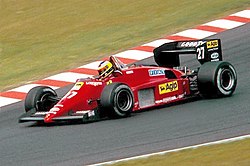
Alboreto at the 1985 German Grand Prix. The Italian took the race win, eleven seconds ahead of the World Champion-to-be Alain Prost.
.mw-parser-output .quotebox{background-color:#F9F9F9;border:1px solid #aaa;box-sizing:border-box;padding:10px;font-size:88%}.mw-parser-output .quotebox.floatleft{margin:0.5em 1.4em 0.8em 0}.mw-parser-output .quotebox.floatright{margin:0.5em 0 0.8em 1.4em}.mw-parser-output .quotebox.centered{margin:0.5em auto 0.8em auto}.mw-parser-output .quotebox.floatleft p,.mw-parser-output .quotebox.floatright p{font-style:inherit}.mw-parser-output .quotebox-title{background-color:#F9F9F9;text-align:center;font-size:larger;font-weight:bold}.mw-parser-output .quotebox-quote.quoted:before{font-family:"Times New Roman",serif;font-weight:bold;font-size:large;color:gray;content:" “ ";vertical-align:-45%;line-height:0}.mw-parser-output .quotebox-quote.quoted:after{font-family:"Times New Roman",serif;font-weight:bold;font-size:large;color:gray;content:" ” ";line-height:0}.mw-parser-output .quotebox .left-aligned{text-align:left}.mw-parser-output .quotebox .right-aligned{text-align:right}.mw-parser-output .quotebox .center-aligned{text-align:center}.mw-parser-output .quotebox cite{display:block;font-style:normal}@media screen and (max-width:360px){.mw-parser-output .quotebox{min-width:100%;margin:0 0 0.8em!important;float:none!important}}
Nigel Roebuck, December 2007[2]
1985 would prove to be Alboreto's most successful year in Formula One. He took two wins: the first at the Canadian Grand Prix,[3] and the second at the German Grand Prix. Alboreto finished the season in second place with 53 points, 20 points behind World Champion Alain Prost. Formula One journalist Nigel Roebuck commented that "Alboreto was Prost's only real challenger for the World Championship".[2] Ultimately it was Ferrari's unreliability which cost Alboreto his chance at the World Championship as he failed to finish the final five races of the season all due to mechanical failure, though he was classified 13th in Italy despite blowing his engine on lap 45 of 51.
Michele Alboreto saw his World Championship dream go up in flames on lap 13 of the 1985 European Grand Prix at Brands Hatch. After stopping to replace a flat-spotted tyre on lap 11, his Ferrari blew its turbo halfway through lap 13. Alboreto, frustrated that Ferrari's late season reliability had cost him the World Championship (he led the points table until Round 11 at Zandvoort) drove the car back to the pits with the rear of the car on fire. He (dangerously) drove the on-fire car into the pits and straight to his Ferrari pit. Many observers saw this as Alboreto's way of showing that the Ferrari's unreliability had cost him the World Championship, which Prost won by finishing 4th in the race.
In 1986 Ferrari's new car, the F1/86 designed by Harvey Postlethwaite, proved to be slower and less reliable than its predecessor as Alboreto retired from a total of nine races: only two of those retirements are counted as driver error while the remaining seven were mechanical failures. Alboreto only scored one podium, at the Austrian Grand Prix – even then both Williams cars of Nigel Mansell and Nelson Piquet had retired and Alboreto finished a full lap behind race winner Alain Prost. The Italian finished the season ninth in the Drivers' Championship with fourteen points. While the Ferrari V6 turbo was rated as one of the more powerful engines on the grid, both Alboreto and teammate Stefan Johansson were hampered by the F1/86 which refused to handle on tracks which had a bumpy surface. Johansson finished 5th in the championship with 23 points despite being the #2 driver in the team, causing many to question why the team chose to re-sign Alboreto and let Johansson go.
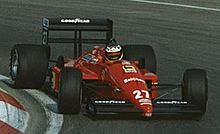
Alboreto driving for Ferrari in his last season with the team, at the 1988 Canadian Grand Prix.
Austrian Gerhard Berger joined Ferrari in 1987 which signalled the end of Alboreto's time as leader of the Ferrari team. Berger soon established himself as the team's number one driver thanks to his wins in Japan and Australia at the end of the season, while Alboreto could only manage a handful of podiums at Imola, Monaco and a second place at the final round in Australia to make it a Ferrari one-two. The Italian finished the year in seventh overall with 17 points, 13 points behind his teammate.
The 1988 season would be Alboreto's final year with Ferrari. With the McLarens of Ayrton Senna and Alain Prost dominating the season, the Ferrari team only managed a single win during the year at the Italian Grand Prix which Berger won from Alboreto in second place. After a disappointing '88 season with Ferrari, the team refused to offer the Italian a new contract and so Alboreto looked elsewhere for a drive. This announcement came at the French Grand Prix in July and pit lane rumours had Michele re-joining Tyrrell for 1989 (in France, where Alboreto finished 3rd and Berger a distant 4th, was the only time in 1988 the Italian would finish in front of the Austrian in a race where both finished). After France he received an offer from Frank Williams, head of the Williams team who would have exclusive use of the new V10 Renault engine in 1989. Later that year before the Italian GP at Monza, Alboreto had not received any word from Williams and requested confirmation of his seat at the team. Williams replied by saying that "he wanted him" and "not to move".[4] The Brit, however, went back on his word and at Monza announced he had signed Belgian Thierry Boutsen instead while also confirming that the teams number 2 driver, Alboreto's former Lancia sportscar teammate Riccardo Patrese, would be staying with the team. As it was late in the season, Alboreto was left with very little options for the coming season.[4]
Alboreto competed in eighty Grands Prix for Ferrari, which established a new record. It stood until the 1995 Argentine Grand Prix, when it was surpassed by Berger.[5]
1989: Tyrrell and Larrousse
A lack of a drive had left Alboreto in a difficult situation and he later admitted he contemplated retirement – an option of which his family were very much in favour.[6] Soon enough, however, he was offered a drive at his former employer Tyrrell, which he accepted. The relationship between Alboreto and team boss, Ken Tyrrell, soon turned sour. At the Monaco Grand Prix, Alboreto was told to drive the 1988 model Tyrrell 017, due to the newer 018 model not being completed.[7] Teammate Jonathan Palmer was chosen to drive the new monoshock 018. Meanwhile, the Italian would have to wait until the following day for the 018 and so he decided not to accept this.[7] The result was Alboreto boycotting the Thursday practice session.[7] This lack of professional behaviour did not impress the team. Alboreto finished the race in fifth position during while Palmer finished ninth. This was followed by a strong performance at the next race in Mexico, where Alboreto finished 3rd – the only podium the team would achieved during the season.
By the French Grand Prix, Ken Tyrrell had found a new sponsor in Camel cigarettes for the race and told Alboreto to end his personal sponsorship deal with Marlboro,[8] a rival brand to Camel. Alboreto was disappointed, as thanks to his Marlboro backing, the team had managed to fund his wages.[7] Following Alboreto's refusal to cut his ties with his sponsor, Tyrrell replaced him with the up-and-coming Jean Alesi. Alesi enjoyed a successful first Grand Prix in which he finished fourth.[8]
Alboreto soon lost his Marlboro sponsorship as well after they refused to find him another drive for the rest of the 1989 season.[9] He was, however, soon hired by the French Larrousse team, incidentally co-sponsored by Camel, for the German Grand Prix and the rest of the season. Despite his new teammate Philippe Alliot showing that the Lola LC89 with its 625 bhp (466 kW; 634 PS) Lamborghini V12 engine could be a competitive car with high grid positions and challenging for points in various races, Alboreto couldn't come to grips with the LC89 and failed to score a single point for the rest of the season, and twice he actually failed to pre-qualify (though it must be said that pre-qualifying in 1989 was generally dominated by those using Pirelli's superior qualifying tyres, whereas Larrousse used Goodyear rubber). During qualifying for the Hungarian Grand Prix the Italian cut one of the chicanes and broke two of his ribs in the process.[9] After competing the year for two teams, Alboreto finished the year eleventh in the Drivers' Championship with six points.
1990–1992: Footwork
1990 saw Alboreto move to the Arrows team, which was in the process of being sold to sponsor Footwork. It was seen mainly as a "transition year" for him, as the chassis was in its second year and severe uncompetitiveness would be expected. Despite this, the 33-year-old finished in the top ten a number of times and only retired three times. Alboreto finished the season, however, as one of 21 drivers who failed to score a point.
Footwork secured Porsche works engines for 1991 and sponsorship from Japan, as the Footwork company completed its takeover of the team. The package did not, however, live up to its expectations as it failed to qualify a number of times. Soon the overweight and unreliable Porsche engines were replaced by Hart-supplied Cosworth engines for the rest of the season, the short-term fix not improving the team's competitiveness. This would be Alboreto's second season in succession that he failed to score a point.
Thanks to Footwork's Japanese connections the team received a supply of Mugen Honda V10 engines for 1992. The FA13 was reliable in comparison to its predecessor and Alboreto scored points four times, in addition to finishing in seventh place six times. With a season total of six points, the 35-year-old finished the year tenth overall.
1993–1994: Scuderia Italia and Minardi

Alboreto driving for Minardi at the 1994 Monaco Grand Prix
Alboreto joined Italian team Scuderia Italia, which had enjoyed a number of successes in its short history, most notably when Andrea de Cesaris and JJ Lehto had scored podium positions at the 1989 Canadian Grand Prix and 1991 San Marino Grand Prix respectively. At the start of 1993, however, the team moved away from its Dallara-built chassis and onto Lolas, a move considered "disastrous" by many Grand Prix journalists. The Italian failed to score any points over the year, and failed to qualify several times as the slowest runner in the 26-car field. Scuderia Italia withdrew before the end of the season, and merged with fellow Italian team Minardi for 1994.
The Minardi cars proved to be mostly uncompetitive and unreliable, with a total of nine retirements from sixteen rounds. Only a sixth position in Monaco was any consolation for Alboreto. At the end of the season, he decided to retire from Grand Prix racing, with a record of 194 starts and five Grand Prix wins to his name.
At the 1994 San Marino Grand Prix (which itself was overshadowed by the deaths of Ayrton Senna and Roland Ratzenberger), whilst leaving the pitlane after a scheduled stop, Alboreto's car lost his loose right rear wheel which bounced through the Benetton, Ferrari, and Lotus pit areas and crews, injuring several mechanics.
1994–2001: Post-Formula One career
Following his departure from Formula One in 1995, Alboreto embarked on a career in the German Touring Car Championship, known as the Deutsche Tourenwagen Meisterschaft. Racing for Alfa Romeo's factory team, Alfa Corse, the Italian finished 22nd in the championship, scoring four points. Further entries in the International Touring Car Championship and World Sportscar Championship, the latter being with Ferrari, also proved to be fruitless ventures.
Alboreto returned to open-wheel racing in 1996, entering the newly formed Indy Racing League (IRL) with Scandia/Simon Racing. The then 39-year-old competed in all three rounds where he finished fourth on his debut at Walt Disney World Speedway; eighth at the Phoenix International Raceway; and retired, due to gearbox problems, at the 1996 Indianapolis 500, his sole entry into the famous oval race. Alboreto also ran sports prototypes for Scandia/Simon while in the United States, entering the IMSA World Sports Car Championship with a Ferrari 333 SP. He also entered the Le Mans 24 Hours in a Joest Racing-entered Porsche WSC-95 alongside fellow Italian and former F1 teammate Pierluigi Martini and Belgian Didier Theys, but retired due to an engine failure after completing 300 laps.
The following year, Alboreto earned his first, and only, podium in the IRL at the "True Value 200" held in New Hampshire, where he finished third. A further fifth place at Las Vegas earned Alboreto 62 points during his 1997 campaign which resulted in a 32nd place overall in the drivers' championship. 1997 for the Italian, however, would be remembered for winning the Le Mans 24 Hours with the same car as the previous year, but this time alongside Swede Stefan Johansson, another former F1 teammate, and Dane Tom Kristensen,[10] who would later go onto beat Jacky Ickx's record for winning the most Le Mans 24 Hour races. The trio completed 361 laps, one more than second placed Gulf Team Davidoff's BMW-powered McLaren F1 GTR.
This would prove to be the peak of Alboreto's sportscar success as he failed to finish at Le Mans in 1999 with newcomer Audi. However, a third at the 2000 Le Mans 24 Hours, victory at the 2000 Petit Le Mans and a win at the 2001 Sebring 12 Hours gave the Italian some final success prior to his death a month after his win at Sebring.[11]
Death

An Audi R8 as it appeared in 2000 when Alboreto was testing at the Lausitzring.
In April 2001, Alboreto was performing straight-line speed tests in an Audi R8 at the Lausitzring, near Dresden, Germany. A tyre blow-out caused his car to veer off track and crash into a wall, killing him.[11] At the time, Audi gave no reason for his death, citing that the R8 had "already completed thousands of test kilometres on numerous circuits without any problems".[12] Alboreto's death brought much anguish among his family and friends. Michele's cousin Marisa told Italian news agency ANSA "You can't imagine what we're going through as a family. We're really distraught."[12]
Fellow Italian Giancarlo Fisichella dedicated his podium finish at the 2005 Italian Grand Prix to Alboreto, "I know Alboreto was the last Italian on the podium at Monza before me. I was lucky enough to race together with him in touring cars, and he was a great person, really special. I want to dedicate the result to his memory."[13]
Helmet
Alboreto's helmet was blue with a yellow stripe with white edges covering the centre of the helmet. The colours were a tribute to Ronnie Peterson, whose helmet design also used them.[14]
Racing career results
Career summary
| Season | Series | Team Name | Races | Poles | Wins | Points | Final Placing |
|---|---|---|---|---|---|---|---|
1979 | European Formula Three | Euroracing Toyota | 6 | 2 | 0 | 19 | 6th |
Italian Formula Three | Euroracing | ? | ? | 3 | 47 | 2nd | |
1980 | European Formula Three | Euroracing | 14 | 3 | 4 | 60 | 1st |
Italian Formula Three | Euroracing | ? | ? | 1 | 25 | 3rd | |
British Formula 3 | Euroracing | 1 | ? | 0 | 4 | 13th | |
World Championship for Makes | Lancia Corse | 4 | 0 | 0 | NA | NA | |
1981 | Formula One | Tyrrell | 12 | 0 | 0 | 0 | 27th |
European Formula Two | Minardi | 10 | 1 | 1 | 13 | 8th | |
World Endurance Championship | Martini Racing | 4 | 0 | 1 | 37 | 57th | |
1982 | Formula One | Tyrrell | 16 | 0 | 1 | 25 | 7th |
World Endurance Championship | Martini Racing | 8 | 2 | 3 | 63 | 5th | |
1983 | Formula One | Tyrrell | 15 | 0 | 1 | 10 | 12th |
World Endurance Championship | Martini Racing | 5 | 0 | 0 | 2 | 85th | |
European Endurance Championship | Martini Racing | 6 | 0 | 0 | 12 | 28th | |
1984 | Formula One | Ferrari | 16 | 1 | 1 | 30.5 | 4th |
1985 | Formula One | Ferrari | 16 | 1 | 2 | 53 | 2nd |
1986 | Formula One | Ferrari | 16 | 0 | 0 | 14 | 8th |
1987 | Formula One | Ferrari | 16 | 0 | 0 | 17 | 7th |
1988 | Formula One | Ferrari | 16 | 0 | 0 | 24 | 5th |
1989 | Formula One | Tyrrell | 6 | 0 | 0 | 6 | 13th |
Larrousse | 8 | 0 | 0 | 0 | |||
1990 | Formula One | Arrows | 16 | 0 | 0 | 0 | 24th |
1991 | Formula One | Footwork | 16 | 0 | 0 | 0 | 35th |
1992 | Formula One | Footwork | 16 | 0 | 0 | 6 | 10th |
1993 | Formula One | Scuderia Italia | 14 | 0 | 0 | 0 | 29th |
1994 | Formula One | Minardi | 16 | 0 | 0 | 1 | 24th |
1995 | International Touring Car Championship | Alfa Corse | 7 | 0 | 0 | 0 | NC |
Deutsche Tourenwagen Meisterschaft | Alfa Corse | 13 | 0 | 0 | 4 | 22nd | |
1996 | IndyCar Series | Team Scandia | 3 | 0 | 0 | 189 | 11th |
Le Mans 24 Hours | Joest Racing (LMP1) | 1 | 0 | 0 | N/A | NC | |
1997 | IndyCar Series | Team Scandia | 2 | 0 | 0 | 62 | 32nd |
Le Mans 24 Hours | Joest Racing (LMP1) | 1 | 1 | 1 | N/A | 1st | |
1998 | Le Mans 24 Hours | Porsche AG/Joest Racing (LMP1) | 1 | 0 | 0 | N/A | NC |
1999 | American Le Mans Series | Audi Sport Team Joest (LMP) | 1 | 0 | 0 | 24 | 43rd |
Le Mans 24 Hours | Audi Sport Team Joest (LMP) | 1 | 0 | 0 | N/A | 2nd | |
2000 | Le Mans 24 Hours | Audi Sport Team Joest (LMP900) | 1 | 0 | 0 | N/A | 3rd |
2001 | American Le Mans Series | Audi Sport North America (LMP900) | 1 | 0 | 1 | 31 | 20th |
Complete World Sportscar Championship results
(key) (Races in bold indicate pole position) (Races in italics indicate fastest lap)
| Year | Entrant | Class | Chassis | Engine | 1 | 2 | 3 | 4 | 5 | 6 | 7 | 8 | 9 | 10 | 11 | 12 | 13 | 14 | 15 | Pos. | Pts |
|---|---|---|---|---|---|---|---|---|---|---|---|---|---|---|---|---|---|---|---|---|---|
1980 | Lancia Corse | Gr.5 | Lancia Beta Monte Carlo | Lancia 1.4 L4t | DAY | BRH 2 | MUG 2 | MNZ | SIL 4 | NÜR | LMS | GLN 2 | MOS | VAL | DIJ | [N 1] | |||||
1981 | Martini Racing | Gr.5 | Lancia Beta Monte Carlo | Lancia 1.4 L4t | DAY Ret | SEB | MUG DSQ | MNZ | RSD | SIL | NÜR | LMS 8 | PER | DAY | GLN 1 | SPA | MOS | ROA | BRH | 52nd | 37 |
1982 | Martini Racing | Gr.6 | Lancia LC1 | Lancia 1.4 L4t | MNZ Ret | SIL 1 | NÜR 1 | LMS Ret | SPA Ret | MUG 1 | FUJ Ret | BRH Ret | 5th | 63 | |||||||
1983 | Martini Racing | C | Lancia LC2 | Ferrari 268C 2.6 V8t | MNZ 9 | SIL Ret | NÜR Ret | LMS Ret | SPA 11 | FUJ | KYA | 86th | 2 | ||||||||
- Footnotes
^ No drivers' Championship.
Complete 24 Hours of Le Mans results
| Year | Team | Co-Drivers | Car | Class | Laps | Pos. | Class Pos. |
|---|---|---|---|---|---|---|---|
1981 | Martini Racing |  Eddie Cheever Carlo Facetti Eddie Cheever Carlo Facetti | Lancia Beta Monte Carlo | Gr. 5 | 322 | 8th | 2nd |
1982 | Martini Racing | Teo Fabi Rolf Stommelen Rolf Stommelen | Lancia LC1 | Gr. 6 | 92 | DNF | DNF |
1983 | Martini Lancia | Piercarlo Ghinzani Hans Heyer | Lancia LC2 | C | 121 | DNF | DNF |
1996 | Joest Racing | Pierluigi Martini Didier Theys Didier Theys | TWR Porsche WSC-95 | LMP1 | 300 | DNF | DNF |
1997 | Joest Racing |  Stefan Johansson Stefan Johansson Tom Kristensen Tom Kristensen | TWR Porsche WSC-95 | LMP | 361 | 1st | 1st |
1998 | Porsche AG Joest Racing | Stefan Johansson Yannick Dalmas Yannick Dalmas | Porsche LMP1-98 | LMP1 | 107 | DNF | DNF |
1999 | Audi Sport Team Joest | Rinaldo Capello Laurent Aïello | Audi R8R | LMP | 346 | 4th | 3rd |
2000 | Audi Sport Team Joest | Christian Abt Rinaldo Capello | Audi R8 | LMP900 | 365 | 3rd | 3rd |
Complete European Formula Two Championship results
(key) (Races in bold indicate pole position; races in italics indicate fastest lap)
| Year | Entrant | Chassis | Engine | 1 | 2 | 3 | 4 | 5 | 6 | 7 | 8 | 9 | 10 | 11 | 12 | Pos. | Pts |
|---|---|---|---|---|---|---|---|---|---|---|---|---|---|---|---|---|---|
1981 | Minardi Team | Minardi Fly 281 | BMW | SIL 11 | HOC 8 | THR Ret | NÜR 8 | VAL Ret | MUG 14 | PAU Ret | PER 3 | SPA 8 | DON | MIS 1 | MAN | 8th | 13 |
Complete Formula One World Championship results
(key) (Races in bold indicate pole position; races in italics indicate fastest lap)
| Year | Entrant | Chassis | Engine | 1 | 2 | 3 | 4 | 5 | 6 | 7 | 8 | 9 | 10 | 11 | 12 | 13 | 14 | 15 | 16 | WDC | Pts |
|---|---|---|---|---|---|---|---|---|---|---|---|---|---|---|---|---|---|---|---|---|---|
1981 | Tyrrell Racing Team | Tyrrell 010 | Ford Cosworth DFV 3.0 V8 | USW | BRA | ARG | SMR Ret | BEL 12 | MON Ret | ESP DNQ | FRA 16 | GBR Ret | GER DNQ | AUT Ret | NC | 0 | |||||
Tyrrell 011 | NED 9† | ITA Ret | CAN 11 | CPL 13† | |||||||||||||||||
1982 | Team Tyrrell | Tyrrell 011 | Ford Cosworth DFV 3.0 V8 | RSA 7 | BRA 4 | USW 4 | SMR 3 | BEL Ret | MON 10 | DET Ret | CAN Ret | NED 7 | GBR NC | FRA 6 | GER 4 | AUT Ret | SUI 7 | ITA 5 | CPL 1 | 8th | 25 |
1983 | Benetton Tyrrell Team | Tyrrell 011 | Ford Cosworth DFV 3.0 V8 | BRA Ret | USW 9 | FRA 8 | SMR Ret | 12th | 10 | ||||||||||||
Ford Cosworth DFY 3.0 V8 | MON Ret | BEL 14 | DET 1 | CAN 8 | GBR 13 | GER Ret | AUT Ret | ||||||||||||||
Tyrrell 012 | NED 6 | ITA Ret | EUR Ret | RSA Ret | |||||||||||||||||
1984 | Scuderia Ferrari SpA SEFAC | Ferrari 126C4 | Ferrari 031 1.5 V6t | BRA Ret | RSA 11† | BEL 1 | SMR Ret | FRA Ret | MON 6‡ | CAN Ret | DET Ret | DAL Ret | GBR 5 | GER Ret | AUT 3 | NED Ret | ITA 2 | EUR 2 | POR 4 | 4th | 30.5 |
1985 | Scuderia Ferrari SpA SEFAC | Ferrari 156/85 | Ferrari 031 1.5 V6t | BRA 2 | POR 2 | SMR Ret | MON 2 | CAN 1 | DET 3 | FRA Ret | GBR 2 | GER 1 | AUT 3 | NED 4 | ITA 13† | BEL Ret | EUR Ret | RSA Ret | AUS Ret | 2nd | 53 |
1986 | Scuderia Ferrari SpA SEFAC | Ferrari F1/86 | Ferrari 032 1.5 V6t | BRA Ret | ESP Ret | SMR 10† | MON Ret | BEL 4 | CAN 8 | DET 4 | FRA 8 | GBR Ret | GER Ret | HUN Ret | AUT 2 | ITA Ret | POR 5 | MEX Ret | AUS Ret | 9th | 14 |
1987 | Scuderia Ferrari SpA SEFAC | Ferrari F1/87 | Ferrari 033D 1.5 V6t | BRA 8† | SMR 3 | BEL Ret | MON 3 | DET Ret | FRA Ret | GBR Ret | GER Ret | HUN Ret | AUT Ret | ITA Ret | POR Ret | ESP 15† | MEX Ret | JPN 4 | AUS 2 | 7th | 17 |
1988 | Scuderia Ferrari SpA SEFAC | Ferrari F1/87/88C | Ferrari 033E 1.5 V6t | BRA 5 | SMR 18† | MON 3 | MEX 4 | CAN Ret | DET Ret | FRA 3 | GBR 17† | GER 4 | HUN Ret | BEL Ret | ITA 2 | POR 5 | ESP Ret | JPN 11 | AUS Ret | 5th | 24 |
1989 | Tyrrell Racing Organisation | Tyrrell 017B | Ford Cosworth DFR 3.5 V8 | BRA 10 | 11th | 6 | |||||||||||||||
Tyrrell 018 | SMR DNQ | MON 5 | MEX 3 | USA Ret | CAN Ret | FRA | GBR | ||||||||||||||
Equipe Larrousse | Lola LC89 | Lamborghini 3512 3.5 V12 | GER Ret | HUN Ret | BEL Ret | ITA Ret | POR 11 | ESP DNPQ | JPN DNQ | AUS DNPQ | |||||||||||
1990 | Footwork Arrows Racing | Arrows A11B | Ford Cosworth DFR 3.5 V8 | USA 10 | BRA Ret | SMR DNQ | MON DNQ | CAN Ret | MEX 17 | FRA 10 | GBR Ret | GER Ret | HUN 12 | BEL 13 | ITA 12† | POR 9 | ESP 10 | JPN Ret | AUS DNQ | NC | 0 |
1991 | Footwork Grand Prix International | Footwork A11C | Porsche 3512 3.5 V12 | USA Ret | BRA DNQ | SMR DNQ | NC | 0 | |||||||||||||
Footwork FA12 | MON Ret | CAN Ret | MEX Ret | ||||||||||||||||||
Footwork FA12C | Ford Cosworth DFR 3.5 V8 | FRA Ret | GBR Ret | GER DNQ | HUN DNQ | BEL DNPQ | ITA DNQ | POR 15 | ESP Ret | JPN DNQ | AUS 13 | ||||||||||
1992 | Footwork Grand Prix International | Footwork FA13 | Mugen-Honda MF-351H 3.5 V10 | RSA 10 | MEX 13 | BRA 6 | ESP 5 | SMR 5 | MON 7 | CAN 7 | FRA 7 | GBR 7 | GER 9 | HUN 7 | BEL Ret | ITA 7 | POR 6 | JPN 15 | AUS Ret | 10th | 6 |
1993 | Lola BMS Scuderia Italia | Lola T93/30 | Ferrari 040 3.5 V12 | RSA Ret | BRA 11 | EUR 11 | SMR DNQ | ESP DNQ | MON Ret | CAN DNQ | FRA DNQ | GBR DNQ | GER 16 | HUN Ret | BEL 14 | ITA Ret | POR Ret | JPN | AUS | NC | 0 |
1994 | Minardi Scuderia Italia | Minardi M193B | Ford HBC7/8 3.5 V8 | BRA Ret | PAC Ret | SMR Ret | MON 6 | ESP Ret | 24th | 1 | |||||||||||
Minardi M194 | CAN 11 | FRA Ret | GBR Ret | GER Ret | HUN 7 | BEL 9 | ITA Ret | POR 13 | EUR 14 | JPN Ret | AUS Ret |
† Did not finish, but was classified as he had completed more than 90% of the race distance.
‡ Race was stopped with less than 75% of laps completed, half points awarded.
Complete Deutsche Tourenwagen Meisterschaft results
(key) (Races in bold indicate pole position) (Races in italics indicate fastest lap)
| Year | Team | Car | 1 | 2 | 3 | 4 | 5 | 6 | 7 | 8 | 9 | 10 | 11 | 12 | 13 | 14 | Pos. | Pts |
|---|---|---|---|---|---|---|---|---|---|---|---|---|---|---|---|---|---|---|
1995 | Schübel Engineering | Alfa Romeo 155 V6 Ti | HOC 1 15 | HOC 2 7 | AVU 1 12 | AVU 2 8 | NOR 1 14 | NOR 2 Ret | DIE 1 11 | DIE 2 11 | NÜR 1 13 | NÜR 2 Ret | ALE 1 Ret | ALE 2 DNS | HOC 1 16 | HOC 2 15 | 22nd | 4 |
Complete International Touring Car Championship results
(key) (Races in bold indicate pole position) (Races in italics indicate fastest lap)
| Year | Team | Car | 1 | 2 | 3 | 4 | 5 | 6 | 7 | 8 | 9 | 10 | Pos. | Pts |
|---|---|---|---|---|---|---|---|---|---|---|---|---|---|---|
1995 | Schübel Engineering | Alfa Romeo 155 V6 Ti | MUG 1 Ret | MUG 2 DNS | HEL 1 Ret | HEL 2 Ret | DON 1 Ret | DON 2 17 | EST 1 Ret | EST 2 DNS | MAG 1 DNS | MAG 2 Ret | 28th | 0 |
American Open-Wheel racing results
(key) (Races in bold indicate pole position)
Indy Racing League
| Year | Team | Chassis | Engine | 1 | 2 | 3 | 4 | 5 | 6 | 7 | 8 | 9 | 10 | Pos. | Pts |
|---|---|---|---|---|---|---|---|---|---|---|---|---|---|---|---|
1996 | Team Scandia | Lola T95/00 | Ford XB V8t | WDW 4 | PHX 8 | 11th | 189 | ||||||||
Reynard 95i | INDY 30 | ||||||||||||||
1996–1997 | Team Scandia | Reynard 95i | Ford XB V8t | NHA 3 | LVS 5 | WDW | PHX | INDY | TXS | PPR | CLT | NHA | LVS | 32nd | 62 |
| Years | Teams | Races | Poles | Wins | Podiums (Non-win) | Top 10s (Non-podium) | Indianapolis 500 Wins | Championships |
|---|---|---|---|---|---|---|---|---|
| 2 | 1 | 5 | 0 | 0 | 1 | 3 | 0 | 0 |
Indianapolis 500
| Year | Chassis | Engine | Start | Finish | Team |
|---|---|---|---|---|---|
1996 | Reynard | Ford-Cosworth | 12 | 30 | Scandia |
Complete American Le Mans Series results
(key) (Races in bold indicate pole position) (Races in italics indicate fastest lap)
| Year | Entrant | Class | Chassis | Engine | 1 | 2 | 3 | 4 | 5 | 6 | 7 | 8 | 9 | 10 | 11 | 12 | Rank | Points |
|---|---|---|---|---|---|---|---|---|---|---|---|---|---|---|---|---|---|---|
1999 | Audi Sport Team Joest | LMP | Audi R8R | Audi 3.6 V8t | SEB 3 | ATL | MOS | SON | POR | PET | LAG | LVS | 43rd | 24 | ||||
2000 | Audi Sport North America | LMP | Audi R8 | Audi 3.6 V8t | SEB 2 | PET 1 | LAG | LVS | ADE | 27th | 44 | |||||||
Audi R8R | CLT 8 | SIL | NÜR | SON | MOS | TEX | POR | |||||||||||
2001 | Audi Sport North America | LMP900 | Audi R8 | Audi 3.6 V8t | TEX | SEB 1 | DON | JAR | SON | POR | MOS | MOH | LAG | PET | 22nd | 31 |
References
Websites
Rainer Nyberg and Mattijs Diepraam. "Nearly Ascari's successor". 8W – Who?. Retrieved 18 March 2008..mw-parser-output cite.citation{font-style:inherit}.mw-parser-output .citation q{quotes:"""""""'""'"}.mw-parser-output .citation .cs1-lock-free a{background:url("//upload.wikimedia.org/wikipedia/commons/thumb/6/65/Lock-green.svg/9px-Lock-green.svg.png")no-repeat;background-position:right .1em center}.mw-parser-output .citation .cs1-lock-limited a,.mw-parser-output .citation .cs1-lock-registration a{background:url("//upload.wikimedia.org/wikipedia/commons/thumb/d/d6/Lock-gray-alt-2.svg/9px-Lock-gray-alt-2.svg.png")no-repeat;background-position:right .1em center}.mw-parser-output .citation .cs1-lock-subscription a{background:url("//upload.wikimedia.org/wikipedia/commons/thumb/a/aa/Lock-red-alt-2.svg/9px-Lock-red-alt-2.svg.png")no-repeat;background-position:right .1em center}.mw-parser-output .cs1-subscription,.mw-parser-output .cs1-registration{color:#555}.mw-parser-output .cs1-subscription span,.mw-parser-output .cs1-registration span{border-bottom:1px dotted;cursor:help}.mw-parser-output .cs1-ws-icon a{background:url("//upload.wikimedia.org/wikipedia/commons/thumb/4/4c/Wikisource-logo.svg/12px-Wikisource-logo.svg.png")no-repeat;background-position:right .1em center}.mw-parser-output code.cs1-code{color:inherit;background:inherit;border:inherit;padding:inherit}.mw-parser-output .cs1-hidden-error{display:none;font-size:100%}.mw-parser-output .cs1-visible-error{font-size:100%}.mw-parser-output .cs1-maint{display:none;color:#33aa33;margin-left:0.3em}.mw-parser-output .cs1-subscription,.mw-parser-output .cs1-registration,.mw-parser-output .cs1-format{font-size:95%}.mw-parser-output .cs1-kern-left,.mw-parser-output .cs1-kern-wl-left{padding-left:0.2em}.mw-parser-output .cs1-kern-right,.mw-parser-output .cs1-kern-wl-right{padding-right:0.2em}
"GP Encyclopaedia – Michele Alboreto". GrandPrix.com. Retrieved 9 July 2008.
- Race results taken from:
- Formula One – "Official Formula One Website's Results archive (1981–1994)". Official Formula One website. Archived from the original on January 21, 2008. Retrieved 19 March 2008.
- Formula Two – Stefan Örnerdal and Andrew Horrox. "Le Mans & F2 Register". Formula2.net. Archived from the original on 11 October 2007. Retrieved 19 March 2008.
- IndyCar – "Stats: Michele Alboreto Career Stats". Official IRL Website. Retrieved 19 March 2008.
[dead link]
- Sportscars – "World Sportscar Championship". Classiccars.com. Archived from the original on September 27, 2007. Retrieved 19 March 2008.
- Formula One – "Official Formula One Website's Results archive (1981–1994)". Official Formula One website. Archived from the original on January 21, 2008. Retrieved 19 March 2008.
Notes
^ abc GrandPrix.com, Paragraph One
^ ab Roebuck, Nigel (12 December 2007). "Ask Nigel:Memories of Michele Alboreto". Autosport.com. Retrieved 18 March 2008.
^ "ALBORETO WINS CANADIAN GRAD PRIX". The New York Times. 17 June 1985. Retrieved 1 October 2012.
^ ab Nyberg and Diepraam, Paragraph 6
^ FIA Formula 1 World Championship – 1995 Season Review (VHS). Duke Video. 11 December 1995. Event occurs at 25:10–25:30. EAN-13 5 017559 034955. Retrieved 20 August 2008.
^ Nyberg and Diepraam, Paragraph 7
^ abcd Nyberg and Diepraam, Paragraph 9
^ ab Nyberg and Diepraam, Paragraph 10
^ ab Nyberg and Diepraam, Paragraph 11
^ "Motor racing: Alboreto pilots Porsche through fiery finish". The Independent. 16 June 1997. Retrieved 1 October 2012.
^ ab Alboreto Is Killed Testing Audi R8, New York Times, April 26, 2001, Page D7.
^ ab "Alboreto dies in crash". BBC Sport. 26 April 2001. Retrieved 17 March 2008.
^ "Fisichella Dedicates Podium to Alboreto". Autosport Official Website. 5 September 2008. Retrieved 2 April 2008.
^ "Grand Prix Hall of Fame – Ronnie Peterson – Images". Retrieved 18 November 2011.
External links
 | Wikimedia Commons has media related to Michele Alboreto. |
- Michele Alboreto in focus
| Sporting positions | ||
|---|---|---|
| Preceded by Alain Prost | European Formula 3 Champion 1980 | Succeeded by Mauro Baldi |
| Preceded by Hans-Joachim Stuck Nelson Piquet | Winner of the 1000 km Nürburgring 1982 with: Teo Fabi Riccardo Patrese | Succeeded by Jochen Mass Jacky Ickx |
| Preceded by Manuel Reuter Davy Jones Alexander Wurz | Winner of the 24 Hours of Le Mans 1997 with: Stefan Johansson Tom Kristensen | Succeeded by Laurent Aïello Allan McNish Stéphane Ortelli |
| Preceded by Frank Biela Tom Kristensen Emanuele Pirro | Winner of the 12 Hours of Sebring 2001 with: Laurent Aïello Rinaldo Capello | Succeeded by Rinaldo Capello Christian Pescatori Johnny Herbert |
 Tyrrell Racing Tyrrell Racing | |
|---|---|
|

| Scuderia Ferrari | |
|---|---|
| Key personnel |
|
| Current drivers |
|
| Test drivers |
|
| Ferrari Driver Academy |
|
| World champions |
|
| Drivers' titles |
|
| Constructors' titles |
|
| Race winners |
|
| Former personnel |
|
Formula One cars |
|
IndyCar/CART cars |
|
| Sports racing cars |
|
| |


| Minardi F1 Team | |
|---|---|
|


Authority control  |
|
|---|


